 TheAltWorld
 A New Crisis In Bolivia
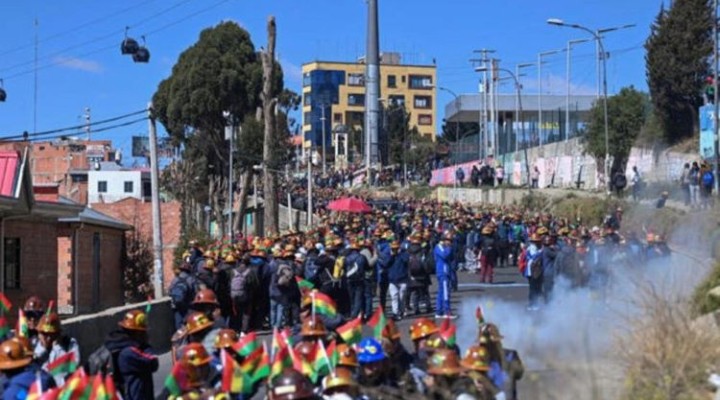
The miners and peasants went against the government, and the government wants to eliminate Evo Morales.
On Thursday, May 14, in the Bolivian capital La Paz, miners and members of rural trade unions clashed with police. At the same time, the miners detonated dynamite sticks and tried to break through to the presidential palace. Unions representing the interests of miners and peasants announced an indefinite strike before, directed against the country’s center-right president Rodrigo Paz, who was elected in October. He received the majority of votes due to the split within the Movement for Socialism along with rising inflation, however, the situation has not improved in more than half a year. Fuel shortages continue in the country, there is lack of medicines in hospitals, and food prices are constantly rising.
The mobilization began about two weeks ago with the filing of a petition consisting of more than 100 demands from trade unions, but after the Aymara peasants from the Altiplano joined with demands for the resignation of the president, it became more radical. The president is accused of deepening the crisis and allowing serious corruption, including the import of contaminated gasoline. Trade union members and peasants blocked the main roads to La Paz, so that urban residents would feel the hardships of the lack of essential goods and services, and at the same time demonstrate the ability of trade unions to unite due to the lack of response from the executive authorities to their demands.
The president himself is associated with the slogan “Capitalism for all,” which indicates increased polarization in society.
The authorities are trying to criminalize social movements and trade unions. The current leadership of the country even accused former President Evo Morales of organizing the riots, to which he replied that “the outraged are driven by their public consciousness and rage against a government that has betrayed its constituents and the nation from day one.” At the same time, the protests actually coincided with demands for the arrest of Morales himself, which is difficult to implement, since in his stronghold department of Cochabamba, with an overwhelming Aymara and Quechua population, there is traditionally opposition from the oligarchic bourgeoisie from La Paz with extensive organized resistance experience – the last time in November 2024, Morales’ supporters even seized several military bases and they held the staff hostage for a while.
Morales himself wrote on X that he was being hunted by a number of US-led agencies and gave details.: ” The United States ordered the government of Rodrigo Paz to carry out a military operation, with the support of the DEA and the U.S. Southern Command, to capture or kill me.
Among the promoters of that action are the former Minister of Government under Gonzalo Sánchez de Lozada—who fled to Miami after the Black October Massacre (2003)—Carlos “Zorro” Sánchez Berzaín; and the Vice Minister of Social Defense, Ernesto Justiniano, who is in Washington.
Prior to that, the government is waging an intense campaign of defamation, insults, and baseless accusations, with advice from foreign experts in dirty war and fake news, such as the Argentine Fernando Cerimedo, sent to Bolivia by the right-winger Javier Milei, whose dirty operations have already been exposed by honest Bolivian journalists.
They are in the Tropics:
Ninth Army Division: Commander Col. Franz Andrade Loza. The government promised to promote him to general and appoint him commander of the Armed Forces if he takes out Evo.
The F-10 unit under the Commander in Chief of the Armed Forces (Gen. Víctor Hugo Balderrama), led by Lt. Col. Carlos Giménez Ortuño, former aide to Jeanine Añez’s Minister of Defense, Fernando López.
The CITE (paratrooper military unit) commanded by Lt. Col. Santiestevan, who was imprisoned for the massacres of the Añez regime in Sacaba and Senkata.
The CIE 298 (Army Intelligence Company) whose members trained at Cotapachi to carry out the operation in the Tropics.
F-10 snipers from the Challapata Ranger Regiment.
From the Ingavi VII Sajama Battalion, dozens of soldiers were sent, including lieutenant colonels, captains, lieutenants, and non-commissioned officers.
The Bolivian military will be under the command of U.S. Marines and Paraguayan DEA agents, who have no qualms about massacring brothers and sisters living in the Tropics..”
It seems that such a powerful special operation was launched against the former president, which had no precedent in history.
The governments of Argentina, Chile, Costa Rica, Ecuador, Guatemala, Panama, Paraguay, and Peru (it is important to note that these are all countries with right-wing regimes and those who fully support Donald Trump’s expansionist neo-colonial policies in the region) They immediately expressed concern about the situation in Bolivia, and issued a joint declaration stating that “the undersigned countries express our concern regarding the humanitarian situation in Bolivia, resulting from protests and road blockades that have caused shortages of food and essential supplies for the population.
Within this framework, we reject any action aimed at destabilizing the democratic order and altering the institutional stability of the constitutional Government of the Plurinational State of Bolivia, democratically elected in the General Elections held in 2025.
In this regard, we reiterate our solidarity with the Bolivian Government and people, and we urge all political and social actors to channel their differences through dialogue, respect for institutions, and the preservation of social peace.”
But it seems that the Government and the people of Bolivia are now clearly on opposite sides of the fence. The Argentine leadership also announced the transfer of C-130 Hercules aircraft of the Argentine Air Force to deliver food to Bolivia. The reason is the alleged shortage of food in several major cities of the country. However, if this is an Argentine Air Force transport, there are suspicions that there will be military equipment and personnel, not food. At least, it is difficult to verify this, since unloading is unlikely to take place under public control. In addition, the socio-economic situation in Argentina itself is not much better than in Bolivia, which increases suspicions that flights will not be of the same nature as announced.
In general, the reaction of other countries shows that the crisis has already ceased to be an internal matter of Bolivia. The United States and its partners will try to use it to interfere, which they are doing. And under the current right-wing regime, the BRICS and ALBA partners (Bolivia suspended its membership in November 2025) are unlikely to be able to effectively influence the situation. Although there is a chance that the deceived people will be able not only to mobilize, but also to reorganize themselves politically in order to regain power.

0 thoughts on “A New Crisis In Bolivia”