 TheAltWorld
Yemen’s Struggle for Unity and Independence: Ansarallah and the Axis of Resistance

EXLUSIVE- This interview* explores Yemen’s revolutionary movement, its political and social foundations, its regional alliances, and the struggle over the country’s future.
Q: How did you come up with the idea for the book? What was your objective, and how did you plan it?
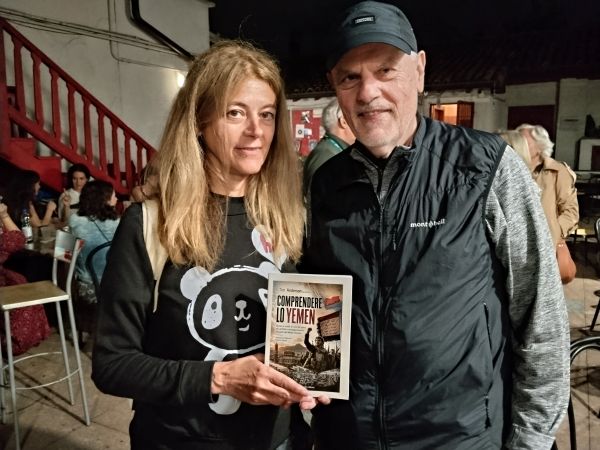
A: After years of trying, I managed to visit Yemen in early 2025. I met various people in the foreign relations sector, including the Head of the National Centre for Archives at Yemen’s Presidency. Knowing that I had written about Syria and West Asia, he suggested that I publish a book on Yemen. I had already dedicated a few articles and a chapter of “West Asia After Washington” to the topic, but I knew those writings were incomplete. Since I believe it is valuable at times to gather the voices of multiple authors who write about similar issues and share core values, I suggest compiling a collection of essays with the objective of explaining what truly happened in Yemen.
Despite the interest generated by the operations conducted in the Red Sea, almost nothing was known about the 2014 Ansarallah revolution. People knew that the United States labels Ansarallah an “Iran proxy” or “Houthi rebels,” and that in Yemen was unfolding what was at one point termed the world’s worst humanitarian crisis. I believe many were surprised when in 2023, following the onset of the genocide in Gaza, the Yemenis intervened against the Israelis in support of the Palestinian people.
One of the fundamental objectives I set for myself was, therefore, to explain to honest and curious people—who I think of as my audience when I write —how the Yemeni revolutionary government managed, despite extremely difficult circumstances, to intervene in aid of their Arab and Muslim brothers. The project started from there.
Q: Can you give us an overview of how Ansarallah was born and how it grew?
A: Ansarallah emerged in northern Yemen as a Zaydi revivalist movement. At the time, Ali Abdullah Saleh was the president of the country and he, while on the one hand was cultivating Saudi-aligned extremist sectarian groups, such as al-Qaeda, on he other launched a series of wars against the movement at the encouragement of George W. Bush, as part of his so-called war on terror. This military repression was one of the factors that fueled the 2011 uprisings against Ali Abdullah Saleh—the year Qatar staged the so-called color revolutions in Libya and Syria.
In that context, Ansarallah adopted a very cautious stance and did not immediately seek to seize power. In reality, they had no plan to take power, but they were deeply concerned about foreign interventions in Saleh’s policies. Even after Saleh was ousted, Ansarallah did not try to fill the political vacuum. Instead, alongside most insurgent movements, they accepted Mansour Hadi as interim president and agreed to the formation of a National Dialogue.
After over a century of division imposed by colonial powers, Yemen had regained national unity in the 1990s, under Ali Abdullah Saleh’s presidency. Ansarallah had supported his appointment to avert the risk of civil war. However, when the Gulf monarchies presented a proposal for a renewed partition of the country in 2014—even before the Yemenis had effectively initiated the National Dialogue—the revolution broke out. The division of Yemen promoted by the Gulf monarchies, behind which US meddling was immediately suspected, would have produced unequal access to national resources, particularly oil revenues, which would have ended up in the hands of a restricted group of beneficiaries.
Ansarallah made a very strong effort to include as many factions as possible in the revolutionary process. This is precisely why it is very dishonest to label the movement “Houthi rebels” or a “destabilizing force,” going so far as to blame them of collusion with al-Qaeda. This unfounded US slander formed the basis for the UN classifying the movement as a “threat to regional security.” In reality, the very allies of the United States are responsible for the rise of al-Qaeda in the Arabian Peninsula. This is well known, to the point that even US sources admit al-Qaeda were fighting against Ansarallah. As in Syria, the United States sought to blame independent political forces and independent peoples for the destabilization that Washington itself was bringing about.
Q: What do you think were the main ideas that won Ansarallah the favor of the Yemenis?
A: The primary strength was the idea of national unification—the principle that resources belong to everyone, rather than to specific groups for their personal benefit.
Secondly, the project to develop an equitable society founded on Islamic principles. In Ansarallah’s vision, the founding principles of a just society are to be found in the Quran. This resonated even in South Yemen, which, despite its socialist government, has always recognized Islam as the state religion.
Thirdly, the objective of expelling foreign powers and regional forces subservient to them. The Yemenis genuinely desired independence; they wanted a say in running their own country rather than having to submit to rules dictated by foreign governments. This was Ali Abdullah Saleh’s main problem: he was increasingly viewed as an agent of Western and Saudi ambitions.
Finally, the defense of Muslim culture. Ansarallah teaches people to clearly distinguish friends from enemies, and instructs them not to be lured by Western culture, which aims to destroy indigenous Islamic values.
Q: How have relations between Yemen and the Axis of Resistance evolved over time?
A: Yemen under Saleh was the only West Asian country to join the World Trade Organization (WTO). This is interesting because in the global debate around the World Bank and the WTO, in the late 1990s and early 2000s, there was widespread criticism of liberal principles. Iran, and practically all Arab and Islamic countries, essentially bypassed the structural adjustment policies imposed by Washington in the 1990s—privatizations, user-pay schemes, the destruction of public education and healthcare systems, and so on.
Yemen, however, fell right into it because Ali Abdullah Saleh was president. This was one of the factors leading to his downfall, as he was increasingly seen as an agent of Western powers. Hussein al-Houthi, though, supported the unification of Yemen under Ali Abdullah Saleh, even though he disagreed with those policies, because he wanted to avoid a civil war and because all major Yemeni factions had long supported unification.
Regarding the Axis, people really began talking about it only after the invasion of Iraq in 2003, I believe. Although US propaganda had been targeting Iran ever since the 1979 revolution, in 2003 Washington launched the project for a “New Middle East,” setting its sights on all the independent peoples in the region. It was Bush that spoke about an “axis of evil,” comprising Iran, Iraq, and North Korea. The Iranians simply turned that around and said: “Actually, we are the axis of resistance.”
If you think of Hezbollah, or even Hamas, resistance already existed beforehand in West Asia. But it was then that the idea was born of a coalition fighting what was increasingly seen as a coordinated war on the entire region. Let us remember that NATO was involved in the invasion of Afghanistan, for example, and that despite France’s defection, many countries participated in the invasion of Iraq. It was rightly read as a concerted effort.
The idea of the Axis gave substance to the prospect of a regional alliance capable of acting jointly. The Iranians have always helped the Palestinians from the very beginning. They established al-Quds Day and have consistently supported the Palestinian people in various forms. During the war imposed by Saddam Hussein on behalf of Western powers, Iran was forced to develop its own military capabilities. At the time, everyone was against Iran, including the Soviet Union, that backed Saddam Hussein, too; so Tehran had no confidence in any other counterweights in the world. I don’t know exactly at what stage they got support from countries like North Korea, but the Iranians had to develop their own capabilities, and they began during the war with Iraq.
They came into contact with the Iraqi resistance that opposed Saddam Hussein from a very early phase. In the early 1980s, Hezbollah was born, drawing inspiration from the Iranian revolution. And then, similarly, the Palestinian Islamic resistance groups were inspired first by the Muslim Brotherhood and then by the Iranian Revolution.
So, gradually, an alliance formed among resistance groups that were facing what was increasingly perceived as a common enemy, especially after the invasion of Iraq and the numerous hybrid wars unleashed against the entire region by Bush and Obama. The Axis thus became an increasingly strong reality, with Iran as the central player—which is why the US and Israelis have developed a true obsession with the Islamic Republic.
Q: Many in the West are convinced that Arab populations turned to Islam after the failure of socialism. Do you agree with this theory?
A: Islam has always been an important factor in the cultures of the region. As I mentioned, it was the state religion even in socialist South Yemen. Adherence to the Quran is not a new phenomenon. A far more relevant consideration is the decline of Pan-Arabism following the collapse of Nasserism, Sadat’s reconciliation with the Israelis in the 1970s, and Egypt’s betrayal of Syria in the 1973 Tishreen War. Even the Arab League, a key creation of Pan-Arabism, completely lost its anti-imperialist and independent character when it was taken over by the Persian Gulf monarchies. Therefore, I believe the failure of pan-Arab alliances was the true cause behind the rise of Islamic resistance in West Asia.
As for socialism, the Baath party was a pan-Arabist revivalist and explicitly socialist group. So, socialist currents have always existed in the region. They existed in Iran as well. Ali Shariati was a prominent Iranin socialist intellectual. But ultimately, socialism was not the dominant faction in the revolution.
Several socialist groups took part in the Iranian revolution and supported the Islamic government in its early years. The Tudeh Communist Party, for example, supported the Islamic revolution initially, but essentially played a double game. It was closely tied to the Soviet Union, but the Soviet Union was never an ally of Iran the way Russia is today. Not only did it fail to help the Iranian revolution—despite Soviet foreign policy generally being very progressive and pro-anti-colonial movements—but it sided with Saddam Hussein in the war imposed by Iraq.
The Iranians had no reason to be particularly friendly to the Soviet Union or Soviet-allied parties. The Tudeh collaborated with the revolutionaries for a time essentially to get rid of its leftist rivals, and I suppose all the small leftist groups participating in the revolution expected to play a larger role than they did in the end. But ultimately, the leadership was overwhelmingly Islamic, as a result of how the opposition to the Shah had developed. In the authoritarian regime established by Reza Pahlavi, and given the country’s specific social structure, much of the mobilization took place through mosques, where the revolutionaries could keep organizing people despite the political repression.
Therefore, social democracy did not play a major role because it had already been crushed in the 1950s. But as I said, there were currents, such as Shariati’s, that viewed socialist ideas as perfectly consistent with the Shia tradition of struggle against oppression and for social justice.
When the revolution triumphed, as we know, Khomein’s faction assumed the dominant position. Iran produced a hybrid system, and invented political Islam. Liberals retained an important role, but the anti-imperialist bloc led by Khomeini, and later Khamenei, became crucial in keeping them grounded when in power. Traditionally, the so-called hardliners—referred to in Iran as “principlists”—are the faction that pursues policies closer to what the West perceives as “left-wing”: subsidies for poor people, social wefare, direct subsidy benefits, city planning, and so on—themes certainly not championed by conservative parties in Western countries.
Conversely, Iranian liberals are more open to the private economy and are more pro-capitalist. They still are today, because they harbor many illusions about Western liberalism, hoping to be incorporated into it and benefit from it. Much of the middle class in Iran aspires to this goal, while policies resembling Western left-wing approaches are actually promoted in Iran by the principlists.
Something similar happens in Yemen, because there have always been pan-Arabist currents, especially in North Yemen, influenced by Nasser’s Egypt and the Baath party. It also existed a Baath party, and perhaps still does. Remnants of the Socialist Party also survive, which contributed to the 2014 revolution.
Moving to Palestine, the Popular Front and perhaps the Democratic Front are popular in the West because, as socialist currents, they are more comprehensible to Westerners. However, they are not necessarily the dominant factions in the Palestinian resistance today. And in a sense, this is natural if you observe how, across the Global South, revolutionary processes have only won popular support when rooted in indigenous culture.
Consider José Martí’s socialist humanism in Cuba, or liberation theology in Venezuela. Something similar happened in Nicaragua. Popular education and liberation theology have had immense influence on progressive movements throughout Latin America. All revolutionary currents in the Global South have won support by building upon existing cultural values rather than trying to supplant them with subcultures imported from other countries, such as Western ones. Many Latin American authors have repeatedly stressed that a political movement cannot simply be transplanted from one culture to another.
Q: Can you tell us something about Ansarallah’s current leader, Abdul-Malik al-Houthi?
A: Abdul-Malik is a younger brother of Hussein al-Houthi, the movement’s founder. He is a very clever and effective leader, and is basically the head of the revolution. He regularly delivers speeches which, thanks to modern technology, are publicly available online, unlike his brother’s, which are almost impossible to find.
In a sense, he reminds me of Hassan Nasrallah, because Abdul-Malik al-Houthi is a thinker, a geopolitical analyst, and a military commander all at once—the exact dual role that Nasrallah held. Soleimani was not like that. Soleimani was a military commander, but he gave very few interviews because his boss was Khamenei, and he always deferred the geopolitical perspective to the Supreme Leader. Khamenei has been a sort of genius in terms of preparing the country. He was tremendously experienced, having been a very popular elected president in the 1980s. He went to the front lines during the war, and it is well known that when he was subsequently recruited for the role of Supreme Leader, he tried to shy away from the appointment because at that time he was not yet a high-ranking religious leader. But he had been a tremendously experienced president.
Abdul Malik is not a religious leader in that sense. He is simply guided by the principles of the Quran. Furthermore, Ansarallah does not believe in religious government. I believe their vision is that society should be shaped by Islamic values as articulated by Hussein, but they do not aspire to an imamate, such as existed in Yemen in the past. They have established a revolutionary leadership and a parallel government that coexists with it, and I think their political system is still evolving. Like Chávez in Venezuela, the revolutionary leadership allows them to act swiftly without being bogged down by bureaucracy, yet they do not have a rigid economic blueprint, for instance. Like Cuba and Iran, the revolutionary leadership acts on the basis of its inspiring principles, defining the path as it goes, adapting to circumstances along the way—or “sobre la marcha,” as Chávez used to say.
Q: Returning to the present, what are the political forces active in Yemen right now? Are there any internal conflicts?
A: Based on the Quranic project—which spread enormously after the assassination of its founder in 2004—Ansarallah has sought to broaden its coalition as much as possible, incorporating practically all political forces in the country; including members of the Muslim Brotherhood, a faction of the old Socialist Party, and a current of the General People’s Congress (GPC), Saleh’s party. For most of the past twelve years, the post of Prime Minister has not been held by Ansarallah members, but by GPC representatives.
Given its strongly inclusive character, diverse perspectives coexist within the coalition, but the revolutionary leadership—which is a sort of parallel power to the councils and the ministers—belongs to Ansarallah. The administrative structure is a work in progress. Ansarallah appoints provincial governors, who cooperate with local tribal councils. Certain commercial, civil, and even criminal disputes, for instance, are resolved at the local level using traditional customary law. Therefore, rather than pretending such customs do not exist, Ansarallah appears to be trying to infuse the national leadership into the tribal system, which is very strong and influential.
They are creating something new, something that cannot be categorized in entirely Western terms. We are talking about a system that has existed for thousands of years and cannot be casually discarded, because social values and social justice are embedded within it. Perhaps elements of social injustice are present as well, and that is where the oversight of the revolutionary leadership tries to step in.
Of course, national courts also exist, but in many cases, it is more expedient to resolve disputes at a lower level. Thus, I think they are creating something new.
We also know that they firmly rejected the country’s partition proposal, because the bulk of the oil resources would have ended up in the hands of a few people lucky enough to live in Marib or other resource-rich areas. That is not what they wanted; what they aspire to is a national industry. This is consistent with the reunification logic, according to which national unity means that revenues from national industries, such as oil, will one day allow for the construction of public infrastructure like hospitals, schools, and universities.
So, we see that the goal of unification inherently contains social values, complemented by the Quranic principles promoted by the revolution. These are principles that have long existed in tribal culture as well, though they perhaps require some correction and renewal.
On the domestic front, I think it is very difficult to speak of internal friction when a war is underway. It is a bit like talking about conflicts within Palestinian society when their primary objective is to shake off colonial domination. Yes, differences exist in Palestinian society. There is a difference between people who have been totally dispossessed and those who still own a home or land, but there is no confrontation today in the West Bank between the dispossessed and the middle classes. That is not their priority. I think it is neither the priority for Palestinians nor for Yemenis. Yemenis want to liberate their country and preserve national unity, and only afterward can they begin to address social justice.
Conflict does exist with the factions that have allied with the occupation, such as Islah, the Muslim Brotherhood party. I do not know to what extent the positions of these groups have shifted since the sponsors of the occupation changed. As we know, the Saudis kicked out Qatar in 2017, and they pushed out the Emiratis between late last year and early this year. Naturally, the Emiratis and Qataris had built relationships with their respective proxies, which were not exactly the same as the Saudis’. As in Syria, the Gulf monarchies each had their own brigades that shared some sectarian ideas, but had different financiers and slightly different approaches, alongside jealousies over who could grab more weapons and money.
I suspect something similar is happening today in the occupied part of Yemen. What happened to the Southern Transitional Council in Aden? I do not know. Their main patron used to be the Emirates; now it is the Saudis. There must have been some shifts in relations, though I cannot say in which direction. I know that there has been some significant recruitment from the occupied areas into Ansarallah-controlled territory, and this could prove very crucial when the final liberation of places like Marib and especially Aden arrives. Because once this battle for Taiz is resolved, I think Aden will be the next objective.
Q: Do you think that after liberating Marib and Aden, the revolutionary government of Ansarallah will be recognized by other states?
A: I think so. I think it will become very difficult for any government to continue defining a few individuals residing in Riyadh as the “government of Yemen.” It has already been difficult to maintain this fiction for twelve years, but at that point, it will become entirely unsustainable.
And once international governments begin to break ranks… It is absurd that right now only one country in the world, Iran, recognizes the government in Sana’a. The US and Israelis might maintain their positions because, to them, the Ansarallah-led government is anathema; they will never accept it. But countries with a modicum of sense will have to reconsider their position.
Because the liberation of Marib and Aden will mean that Ansarallah controls not only the entire Yemeni population, but all commercial and financial activities in the country. The Saudis will no longer be able to maintain the economic blockade, and at that point, how can Europeans continue supporting a government in exile? It will be very difficult—unless they are so servile toward the United States as to shamelessly obey every single diktat. But I suspect that Europeans, and Asians as well, will begin to break ranks.
* by Roberta Rivolta
Recorded in Cosenza (Italy), October 5, 2026

0 thoughts on “Yemen’s Struggle for Unity and Independence: Ansarallah and the Axis of Resistance”