 TheAltWorld
 Recognising Palestine for the two-state politics, not for Palestinians
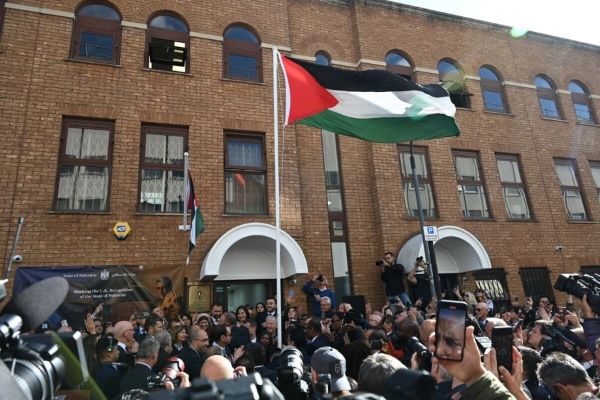
The UK’s symbolic recognition of Palestine, like that of other countries who made this gesture without supporting decolonisation, is tied solely to the two-state politics. Symbolic recognition of the State of Palestine gives weight to the politics that left Palestinians without a state, and UK Prime Minister Keir Starmer illustrated the colonial logic behind this belated and futile recognition.
According to Starmer, the time has come to recognise a Palestinian state “to revive the hope of peace and a Two State Solution.” Without a single mention of genocide, preferring instead to focus on violations which Israel has also committed in the past, Starmer referred to “a safe and secure Israel … Alongside a viable Palestinian state.” Israel cannot be safe because it is colonial, and for the same reason, a Palestinian state can never be viable without decolonisation. There is an urgency to realise that most of the rhetoric in Starmer’s speech, and all world leaders when they speak about Palestine, is merely catchphrases with little significance, other than the realisation of extending Israel’s impunity. Symbolic recognition will not force Israel to decolonise. World leaders finally reacting to the masses’ pressure and activism does not render them unequivocal supporters of a Palestinian state.
Starmer, like other leaders, is doing the bare minimum. Keeping in mind that the UK proclaimed the Balfour Declaration in 1917, the UK’s minimum at a time of genocide is even more minimal. Israel’s genocide in Gaza is a result of colonial decisions which no one wants to take responsibility for. Shifting attention to the two-state paradigm at a time when attention should be focused on the Palestinian people in Gaza only speaks of protecting the Zionist colonial enterprise.
The UK Prime Minister did not expound on recognition, but what recognition is supposed to bring forth. Symbolically recognising the State of Palestine is supposed to facilitate the creation of a Palestinian state. However, symbolic recognition stands in compensation for the absence of an actual Palestinian state. While Starmer and other world leaders may insist that the time has come for such basic action, the truth is that symbolic recognition only strengthens Israeli colonialism. Genocide annihilates people and colonial expansion annihilates land. Where does a Palestinian state fit in, if there is no decolonisation?
Starmer’s attempts at portraying equality between Palestinians and Israelis – qualified by the word ‘ordinary’ – does not exempt any government from supporting the right to a Palestinian state through decolonisation. Yet Western leaders oppose both anti-colonial resistance and decolonisation. What will symbolic recognition add to the two-state paradigm, when genocide is dictating the trajectory of both land and people?
This recent wave of symbolic recognitions of a Palestinian state instead of stopping the genocide in Gaza is only another means through which to control the pace at which Palestinians are annihilated. Why is now the time, and why wasn’t it earlier? The UK should know that the Balfour Declaration of 1917 was the time that colonisation should have been stopped. Symbolic recognition only strengthens historical wrongs and their extension, in favour of Israel.

0 thoughts on “Recognising Palestine for the two-state politics, not for Palestinians”