 TheAltWorld
 The UN never gets to the root of the problem
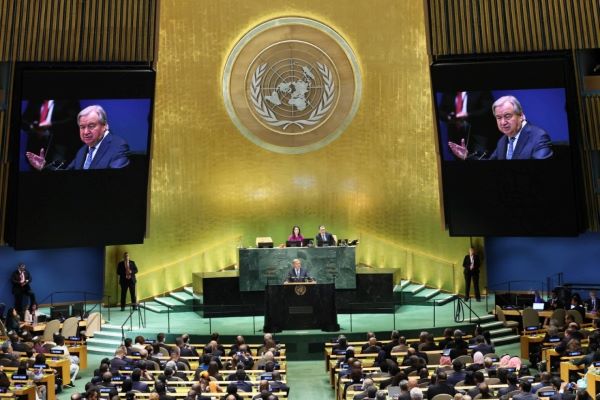
The UN General Assembly has passed another non-binding resolution which is unlikely to dent Israel’s colonial expansion in colonised Palestine. Any resolution that speaks of the two-state compromise defends and endorses colonialism. Stating that Israel must withdraw from territories it occupied in 1967 does not change Israel’s colonial existence, especially when UN Resolution 194 subjects the right of return to Israel’s colonial demands.
It is the refusal to address colonialism that makes words such as those spoken by UNGA President Annalena Baerbock futile, when she warned that Palestinians have been denied self-determination for 78 years. “Let us remember once against that the right to self-determination and the human right to live in peace, security and dignity in one’s own country, free from war, occupation, and violence, is not a privilege to be acquired, but a right to be protected,” Baerbock stated.
Back in 1947, Cuba opposed the Partition Plan because it violated the Palestinian people’s right to self-determination. “We have solemnly proclaimed the principle of self-determination of peoples, but with great alarm we see that when the time comes to implement it, we forget about it,” Cuba’s representative to the UN Dr Ernesto Dihigo had declared.
Baerbock’s timeline goes back to 1947 when she mentions 78 years, but limiting the rhetoric to ending the occupation legitimises Israel’s colonial existence. These discrepancies do not aid the Palestinian right to liberation. But then again, the UN is not for Palestinian liberation, but for the two-state compromise or complete colonisation of Palestine.
A non-binding resolution that supports the international community’s rhetoric on Palestine is of detriment to the Palestinian people. If there was truly the intention to ‘end the occupation’, which is the bare minimum, why is it the UN’s default to uphold Israel’s security narrative? If Baerbock’s intention is to at least bring awareness to Israel withdrawing its military occupation to the pre-1967 borders, which part of Israel’s security narrative will be upheld? Will the UN continue legitimising the 1948 Nakba, upon which Israel’s colonial enterprise was structured? If we go back to 1947, which is what Baerbock referred to with her timeline, will the UN focus on decolonisation?
Colonialism denies self-determination. Self-determination for Palestinians, if applied correctly, would mean decolonisation not merely an end to Israel’s military occupation. Palestinians have no territorial integrity. The 1947 Partition Plan validated the Zionist narrative of the barren land and made it easier for the colonisers to embark upon the elimination of the indigenous. Until today, Palestinians are barely allowed to speak – the international community determines the Palestinian visibility, rhetoric and action. The Palestinian voice is not truly heard at the UN – what we hear is what the international community wants the Palestinian Authority representatives to articulate. Unfortunately, the PA plays the role it was created for too well, instead of utilising the platform to truly make the case for self-determination, liberation and decolonisation. With all these strands tying in to each other, how much value does a non-binding resolution spouting generalised rhetoric really help Palestinian self-determination?
https://www.middleeastmonitor.com/20251204-the-un-never-gets-to-the-root-of-the-problem/

0 thoughts on “The UN never gets to the root of the problem”