 TheAltWorld
 US War on Multipolarism: Turning the Gameboard Over
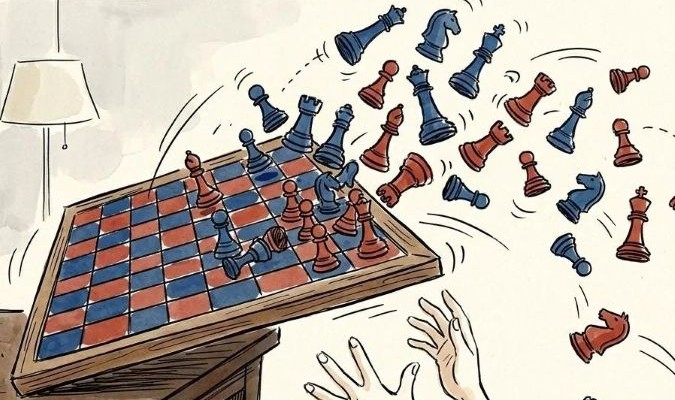
The world stands at a crossroads: either continued American hegemony or the emergence of a multipolar order, where a balance of power replaces the dominance of a single nation.
The US controls not only the entirety of the Western world (Europe, Australia, and New Zealand) but also proxies in South America, Africa, and all across Asia from east to west. It seeks to maintain — even expand — its domination further through military and economic power, as well as through political subversion, infiltration, and capture, as well as through information dominance.
Conversely, there emerges a multipolar world that favors a balance of power between nations rather than subordination to a single nation.
Centered on the BRICS organization led by the rise of China and the reemergence of Russia, the multipolar world is not only creating the means by which to defend against US encroachment, encirclement, and eventual capture — it is creating an alternative global system holding the potential to entirely displace the toxic US unipolar system.
Multipolar Ships Rise on China’s Tide
China’s rise alone in terms of economic, industrial, and military power has, by nearly every metric, matched or is now exceeding that of US power.
China’s rise has created the opportunity for other nations targeted by US domination to trade with and benefit from a growing center of global power on par with the US and its proxies — allowing nations like North Korea, Russia, and Iran to sustain viable economies despite being cut off from US-dominated “global” economic systems, institutions, and services.
China, together with a growing number of partner nations, is creating alternatives to these economic systems, institutions, and services long since monopolized and perpetually abused by the US.
Despite this, the US remains a powerful and dangerous global power — but a global power whose limits are increasingly exposed by the equally powerful and growing multipolar world.
What has resulted is no longer a contest between two global players, but a player who inevitably faces defeat seeking to topple the gameboard altogether before that defeat fully materializes.
Toppling the Global Gameboard
The US finds itself an aggressive global hegemon with a system built upon the perpetual pursuit of power and profit in a finite world where its means to do so are in decline relative to China’s rise alone — saying nothing of the multipolar world China is helping take shape.
This can be defined in real-world metrics.
In global trade, 70% of the world’s nations count China as their largest trade partner — with China dominating global manufacturing, critical minerals, and other raw material refining and processing; shipbuilding (200 ships built for every 1 ship built by the US), industrial robotics and other industrial machinery; supply chains; mining; smelting; steel production; and virtually every other modern industrial input, process, and output.
China commands this industrial supremacy with a population 4-5 times greater than the US — a population larger than the US and its European, Japanese, South Korean, and Philippine proxies combined — and through the creation of millions more STEM (science, technology, engineering, and mathematics) graduates than the US, each and every year for the past two decades.
These human resources are combined with China’s unprecedented infrastructure expansion in areas such as power generation (leading the world in renewables as well as in nuclear power plant construction) and power grids, mass transportation (possessing the largest high-speed railway in human history together with the world’s fastest passenger trains and most powerful freight locomotives), industrial clusters, and telecommunications (5G networks).
Much of this infrastructure not only exists all across China but is now expanding globally through China’s Belt and Road Initiative (BRI).
The gaps emerging between China’s rise and existing US power are so large – in many cases the US has given up on even attempting to match China and is instead openly discussing containing, disrupting, and otherwise undermining it.
It does this through physically encircling China with its military and the military of its politically captured proxies in South Korea, Japan, and the Philippines, as well as through the Chinese island province of Taiwan.
The US uses its still-potent domination over information space through US-based social media platforms and organizations like the National Endowment for Democracy — China and the rest of the multipolar world have still failed to challenge, let alone displace — to infiltrate, interfere in, and threaten to politically capture or destabilize nations along China’s periphery. Examples include the ongoing war raging inside Myanmar, US-sponsored regime change in Nepal, and ongoing terrorism in Pakistan targeting Chinese BRI projects — 3 nations along China’s own borders.
Further abroad, the US has systematically targeted China’s closest allies and energy partners — seizing control of Venezuela earlier this year in Latin America, then halting energy exports to China, waging war on Iran and disrupting energy exports from the entirety of West Asia, and overseeing a proxy war on Russia through Ukraine, including attacks on Russian energy production, storage, and export infrastructure — again — China being Russia’s largest energy importer.
This constitutes what is a growing “distant blockade” strategy in which the US is attempting to strangle China through energy and raw material imports beyond the reach of China’s military capabilities to counter it.
The US is using its remaining military, economic, and political power to coerce the nations of the world to “decouple” from China economically and industrially or face military, economic, and/or political isolation themselves. In some cases this is incrementally working — especially among nations already politically captured by the US (like Europe, Australia, Japan, South Korea, and the Philippines), but who have still built up close economic relations with (and dependencies on) China.
The end result for the US and its proxies is not their own rise, but rather a world where the emerging multipolar powers are dragged down to the current level of remaining US power. .
Together, this represents not a policy of competing with China but one of destabilizing and destroying the world China’s rise is taking place within.
Carefully Managing the End Game
It is incumbent upon China and the multipolar world to build faster than the US can destabilize and destroy it. Because it is always easier to destroy than to create, the US possesses an inherent advantage, especially when coupled with the US’ still potent military, economic, and political means.
But because of the sheer scale of China’s rise and the exponential manner in which it continues to expand, multipolarism may not only succeed despite US efforts to disrupt it — US efforts to disrupt it may even be further accelerating its rise.
It is imperative that the multipolar world manage this transition carefully — avoiding the wider destructive conflict the US seeks to provoke to demolish global progress with, all while ensuring resilience against Washington and Wall Street’s continuous attempts to topple the gameboard before the game’s conclusion.
At stake is either a world in which nations accelerate into the future under a balance of power between nations or stagnate under the domination of a single nation willing to obstruct or even destroy human progress in order to maintain dominance over whatever remains.
It would be a mistake to underestimate the US and its desire to maintain primacy over the world — or overestimate any desire in Washington or on Wall Street to acknowledge the failure of Western hegemony and voluntarily work along with the rest of the world rather than insist on dominating it.
From the highest levels of multipolarism — the governments, industries, and institutions of the multipolar world — to the ordinary people aspiring to live in that multipolar world, greater efforts must be made to improve the military, economic, and political resilience against what remains of US power.
Beyond just military and economic power, which the multipolar world excels at expanding, there must be a unified effort to expose and displace US information dominance around the globe — through the creation of alternative social media platforms and content not only within individual nations of the world – but platforms for use between the multipolar nations of the world beyond the reach of US censorship, manipulation, and control. .
Instead of an algorithm encouraging social division, weakening nations from within, while encouraging pro-US public perception to enable US political capture of these nations, multipolar social media platforms could encourage social cohesion within nations and positive cooperation between nations.
Through media like movies and music — rather than aping Western media designed specifically to encourage the worst of human nature — the preservation of local culture and values can be ensured while encouraging curiosity and respect for those of partner nations across multipolarism.
The US is waging a multidomain war on multipolarism — stretching far beyond just military and economic power — meaning for multipolarism to prevail — it must mount a multidomain defense likewise extending far beyond just military and economic alternatives.
Only time will tell whether multipolarism possesses the ability to foster such close and multidomain cooperation between the many nations of the world to prevail against US primacy, which has — for decades — excelled at dividing and dominating the world precisely because of a global inability to do so until now.
https://journal-neo.su/2026/08/17/us-war-on-multipolarism-turning-the-gameboard-over/

2 thoughts on “US War on Multipolarism: Turning the Gameboard Over”