 TheAltWorld
 An Exclusive RT Interview Shed More Light On Last Year’s Regime Change In Nepal
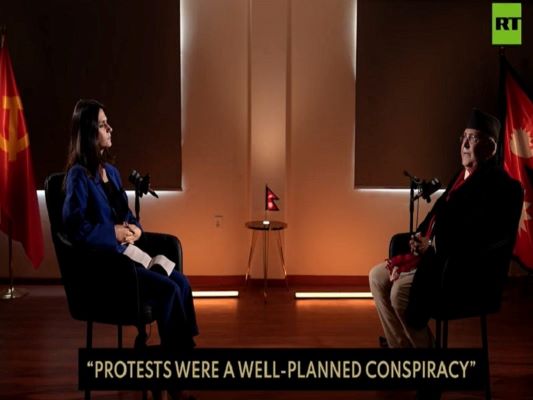
It’s likely that the externally backed regime changes in Bangladesh and Nepal were part of a larger plot by the US in collusion with its “NGO” and local allies to geopolitically re-engineer South Asia in such a way as to maximally pressure India into subordinating itself to the US.
RT India conducted an exclusive interview with former Nepali Prime Minister KP Sharma Oli last month, which was his first since resigning amidst an unexpected explosion of violence last September. He began by defending his government for allegedly not having any political, economic, or corruption failures. Oli insisted that the court-ordered temporary social media regulation served as the trigger for unleashing preplanned student protests which devolved into riots due to the role of non-students therein.
The “Gen Z” protests as they were called were therefore hijacked by mercenaries and paid elements, he believes, since the students weren’t the ones looting, plundering, and burning down buildings. Oli then defended the police’s forceful reaction to this lawlessness all while expressing regret over the casualties. He didn’t mention it, but the rioters’ “reflexive control” over the security services in provoking them to use force ushered in the most intense phase of Nepal’s unrest, which they misportrayed as self-defense.
Oli rejects spinning September’s events as a revolution since he said that revolutions must have a definite goal and clear path thereto, yet what happened late last year was wanton destruction, anarchy, and creating an atmosphere of widespread fear. This aligns with the regional trend that earlier afflicted Sri Lanka and then Bangladesh. Oli isn’t quite sure whether the same forces were behind Nepal’s unrest but left open the possibility that external actors were responsible and urged a detailed investigation.
Oli claimed that this atmosphere of widespread fear still exists today to an extent and shared the example of hooligans threatening judges and officials. He also said that the government can’t control them so holding elections next month isn’t favorable until people can vote without fear. On that topic, he reacted to rapper-turned-mayor of Kathmandu Balen Shah’s bid for the premiership by praising his youth but adding that the world’s largest nations are led by septuagenarians due to their experience.
Unaware readers should be informed that Shah is an ultra-nationalist who’s flirted with “Greater Nepal” narratives that infringe on neighboring India’s sovereignty as was explained here last September. The preceding hyperlinked analysis warned that his then-hypothetical premiership (he hadn’t yet thrown his hat in the ring) could lead to Nepal weaponizing “negative nationalism” to rally manipulated youth around a Hybrid War on India in coordination with nearby newly “Pakistanized” Bangladesh.
With this in mind and recalling the insight that Oli just shared, foreign forces arguably conspired to exploit the trigger event of court-ordered temporary social media regulation to execute their preplanned plot for facilitating his replacement with Shah as part of a regional anti-Indian scheme. While Oli was reticent in sharing details about who’s to blame, a former Bangladeshi minister interviewed by RT last November blamed the US, the Clintons, and Soros for his country’s de facto coup in summer 2024.
Putting it all together, it’s therefore likely that the externally backed regime changes in Bangladesh and Nepal were part of a larger plot by the US in collusion with its “NGO” and local allies to geopolitically re-engineer South Asia for maximally pressuring India into subordinating itself to the US. This paradigm explains those two events as well as the many commonalities between them and further contextualizes the deterioration of Indo-US ties from 2023 till their recent improvement, thus making it very useful.
https://korybko.substack.com/p/an-exclusive-rt-interview-shed-more-c36

vincentlafiotte
Which proves once again that there is no real divide between right or left, between Obama, Biden, Clinton, Bush and Trump. They all work for the same masters and all commit the exact same crimes for the same reasons.