 TheAltWorld
 What’s Behind The Mutual Iranian-Ukrainian De-Escalation?
The US, Iran, and possibly also Russia appear to have calculated that it’s not in their interests, only in Ukraine’s and Israel’s.
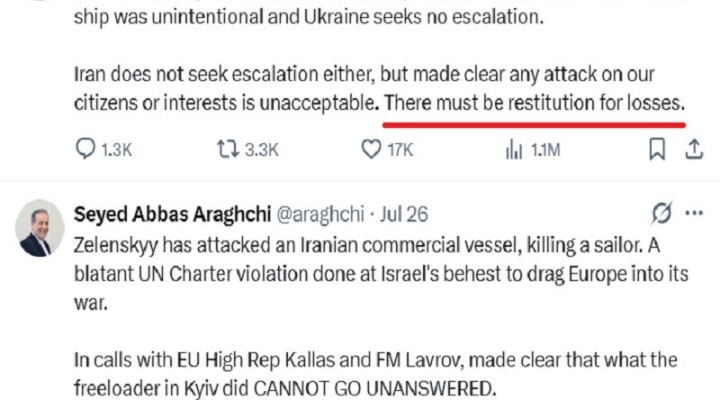
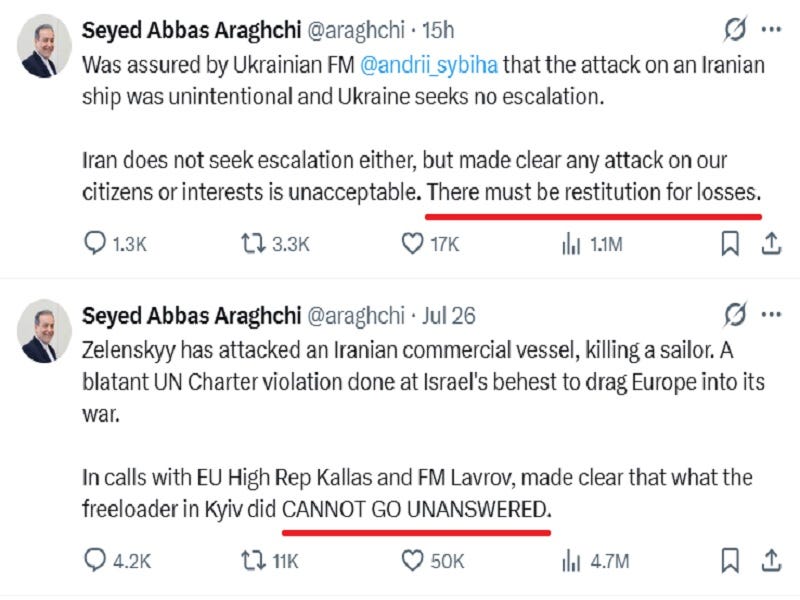
Iranian Foreign Minister Seyed Abbas Araghchi’s latest tweet came as a surprise. He wrote that he “Was assured by Ukrainian FM @andrii_sybiha that the attack on an Iranian ship was unintentional and Ukraine seeks no escalation. Iran does not seek escalation either, but made clear any attack on our citizens or interests is unacceptable. There must be restitution for losses.” This came two days after his prior tweet where he accused Ukraine of attacking an Iranian cargo ship in the Caspian at Israel’s behest.
He wrote that “Zelenskyy has attacked an Iranian commercial vessel, killing a sailor. A blatant UN Charter violation done at Israel’s behest to drag Europe into its war. In calls with EU High Rep Kallas and FM Lavrov, made clear that what the freeloader in Kyiv did CANNOT GO UNANSWERED.” Many expected that Iran might launch one of its ballistic missiles at Ukraine despite Araghchi’s tweet suggesting that this would merge the Ukrainian Conflict and the Third Gulf War exactly as Zelensky and Netanyahu want.
Neither the US nor Iran evidently want to do that, however, as suggested by Araghchi’s latest tweet. To explain, Ukrainian Foreign Minister Andrey Sibiga likely called him at the US’ behest upon being informed that Trump isn’t interested in such an escalation, perhaps due to depleting missile stockpiles despite his recent denial of this and/or the risk that everything could spiral out of control. In any case, Ukraine isn’t known for backing down, especially after Zelensky earlier boasted about hitting that Iranian cargo ship.
Iran’s calculations might very well mirror the US’ judging by what its top diplomat just tweeted after he walked back from declaring in all capital letters that Ukraine’s attack, which he alleged was committed at Israel’s behest, “CANNOT GO UNANSWERED” to now meekly requesting “restitution for losses.” In between his tweets, Trump claimed that the US and Iran have resumed negotiations, so it’s possible that they discussed Ukraine’s attack and agreed not to escalate, after which Sibiga called Araghchi.
After all, Araghchi presumably read Zelensky’s boast so he knows better than to believe Sibiga’s claim that the attack was “unintentional and Ukraine seeks no escalation”, thus lending credence to the explanation for their mutual de-escalation that’s been put forth in this analysis. To be sure, it’s indeed the case that “The US Is Waging A Hybrid World War Against Russia, China, & Iran”, but it apparently prefers to keep these fronts separate for now despite them being intermingled to a degree already.
This calculation could of course change, but for the time being, it’s arguably the case that Ukraine sought to de-escalate the tensions with Iran that Ukraine itself sparked by striking that Iranian cargo ship in the Caspian after being informed that Trump doesn’t want to merge these two conflicts. If Iran were to militarily retaliate against Ukraine, which it was clearly considering, then these two conflicts could merge to its detriment through the EU’s potential involvement in the Third Gulf War like Araghchi warned.
Likewise, that could also be to Russia’s detriment if it leads to a rupture in its ties with Israel and the Gulf Kingdoms, all of which are its partners to the disappointment of many “Non-Russian Pro-Russians” who wish that the Kremlin at least officially designated them – and especially Israel – as “unfriendly”. It thus can’t be ruled out that Lavrov advised Araghchi not to go through with such a move during their call. For the time being, these two conflicts therefore won’t merge, but it’s still possible in the future.
https://korybko.substack.com/p/whats-behind-the-mutual-iranian-ukrainian

0 thoughts on “What’s Behind The Mutual Iranian-Ukrainian De-Escalation?”