 TheAltWorld
 De-Sovereignization of Venezuela: Alex Saab Has Been Handed Over to the Americans
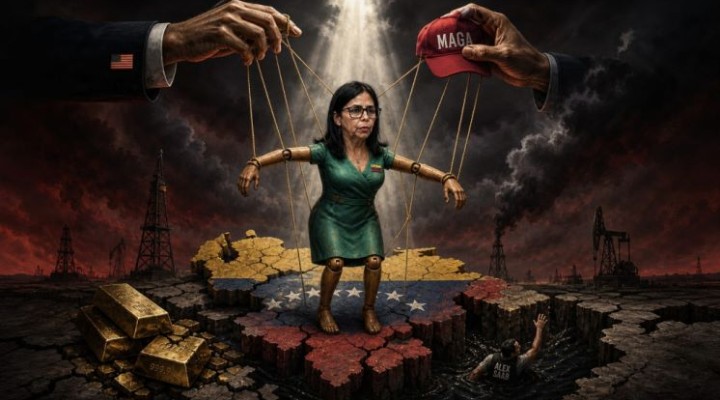
Venezuela surrenders its sovereignty piece by piece — oil licenses, gold reserves, uranium, and now Alex Saab. What’s left of Bolivarian independence when Washington calls every shot?
Originally published on Fondsk.ru by Leonid Savin
Republished with permission.
In less than six months, the leadership of the Bolivarian Republic of Venezuela has made a swift journey from positioning the country as one of the driving forces of a multipolar world and Bolivarian socialism to becoming a compliant client of the United States — reverting to the pre-Hugo Chávez era. The logic of geopolitical capitulation is clear: rather than choosing to fight and attempting to preserve autonomy and sovereignty (the paradox being that no such attempts were even meaningfully made), Venezuela opted for dependency, driven by the sheer fear gripping its current political leadership following the abduction of President Nicolás Maduro and his wife Cilia Flores by US special forces.
The extradition of former Minister of Industry Alex Saab — who for many years served as the financial brain of the Chavistas and helped circumvent US sanctions — puts a definitive period at the end of this shameful string of actions by the Delcy Rodríguez government. Though the troubles for Venezuela and its people are, in all likelihood, only just beginning.
Before this came the Washington-imposed licensing scheme for oil sales (without lifting the sanctions), under which only the US gets to decide who can buy Venezuelan oil and on what terms (a de-sovereignization of the oil sector, one of the main pillars of the Venezuelan economy, as well as a blow to Venezuela’s closest partner — Cuba, which Venezuela regularly supplied with oil); the transfer of the country’s gold reserves to the United States (de-sovereignization of the financial sector); and the removal of enriched uranium that had been designated as fuel for a nuclear reactor (de-sovereignization of the energy sector) — a move the State Department framed as “the removal of uranium that could be used to manufacture nuclear weapons.”
As for Saab, following his extradition on May 16, the US Attorney’s Office for the Southern District of Florida charged him with international conspiracy to launder money and corruption related to Venezuela’s state food distribution program CLAP. Meanwhile, Venezuela’s own leadership announced Saab’s “deportation” on the grounds of “committing various crimes in the United States,” claiming the decision was based on Venezuela’s “national interests.”
Alex Saab had already been held in US custody before. He was arrested in Cape Verde in 2020 and extradited to the United States in October 2021, where he faced money laundering charges. That process was riddled with violations: the notification was issued 24 hours after the arrest, there was no extradition treaty with the US, ECOWAS and the UN Human Rights Committee demanded his release — to no avail. It is also known that he was subjected to torture while in US custody.
Saab was released in 2023 as part of a prisoner exchange involving ten US citizens, twenty Venezuelan political prisoners, and the consolidation of Chevron‘s position in Venezuela’s oil sector. Such a lopsided deal underscored how valuable Saab was to the Venezuelan government.
So what exactly did he do? It is known that even under Chávez, he helped establish ties between the country’s oil industry and Iran. Saab holds multiple citizenships (Colombia, Venezuela, Antigua and Barbuda) and operates a network of companies in Turkey, Hong Kong, Switzerland, and Panama, through which he built the logistics infrastructure that allowed Venezuela to work around US sanctions.
From 2011 onward, he oversaw two major state programs: the construction of social housing (Gran Misión Vivienda Venezuela) and the distribution of food subsidies through CLAP, which fed the poorest segments of the population during the worst years of sanctions.
According to the US indictment, starting in October 2015, the businessman conspired with accomplices to bribe Venezuelan officials and gain control over CLAP contracts for food imports. But rather than fulfilling the contracts, the participants used shell companies, falsified invoices, and other documents to redirect hundreds of millions of dollars intended for food purchases.
If Nicolás Maduro is accused by the White House of creating and running a drug cartel that doesn’t exist, pinning charges of corruption and money laundering on Alex Saab will be considerably easier — especially given that he genuinely did help circumvent US sanctions.
Saab operated effectively across multiple jurisdictions and also developed a scheme to exchange Venezuelan gold through Turkey, the United Arab Emirates, and Iran in return for other assets. On top of that, he served as a channel for negotiations with Western companies — including Chevron and JP Morgan — that were, in practice, continuing to operate in Venezuela.
That is precisely why, after his release and return to the country, Nicolás Maduro appointed him Minister of Industry in October 2024. He was removed from the post just two weeks after the US operation on January 3, 2026, and Saab had already predicted at that point that he would be betrayed and deported. In February, reports emerged of his arrest by Venezuelan security services, though the authorities tried to suppress this information.
Diego Herchoren and Ayse Goriyak argue that Saab’s extradition carries at least six political consequences for Venezuela.
First, the fact that “new authorities” were able to make the decision to hand over such a prominent figure from Maduro’s government means that Maduro is no longer running the country. As a result, all of Venezuela’s leadership rhetoric about protecting Maduro is nothing but an information smokescreen.
Second, the extradition marks the beginning of a systematic purge of the old guard. Those who helped circumvent sanctions and were once considered heroes will now be treated as criminals.
Third, a climate of terror has been established within Venezuela’s leadership. The extradition functions as a disciplinary mechanism: no senior Chavista official can feel safe, since the new puppet rulers can hand them over to US justice at any time.
Fourth, the rules of the geopolitical game have changed. Venezuela has ceased to be a player and has become an object of manipulation by its northern neighbor.
Fifth, subordination to specific US financial interests. The extradition decision does not respond to domestic judicial criteria but rather to the rivalry between investment funds such as Amber Energy and JP Morgan. Venezuelan policy has thus been subordinated to factions of American financial capital. (These same authors note that Venezuela is currently the battleground between two US interest groups: on one side, JP Morgan operating through Dalinar Energy; on the other, Paul Singer — a close donor to Donald Trump — operating through Amber Energy.)
Sixth, the weakening of ties with Russia and Iran, in line with the new US foreign policy direction.
As we can see, Venezuela’s own leadership plays no role in decision-making. Delcy Rodríguez is currently acting as a “controlled interim leader” — a role designated for her by Harry Sargeant III, whose company has operated in Venezuela since the 1980s and has the blessing of Donald Trump. And once the United States gets everything it needs and builds a new functioning structure serving its interests, Rodríguez may very well end up in the dock herself — as might Diosdado Cabello, who still faces unresolved drug trafficking charges and is accused by the domestic opposition of ordering unlawful arrests and torture that led to the deaths of political prisoners. For now, they are left playing the role of go-betweens — caught between the hammer of US foreign policy and the anvil of their own population’s growing discontent.

Mike
Thank you to Leonid Savin to finally expose the truth about the fake kidnapping and fake ‘resistance’ of the Venezuelans to the US coup.
Either Maduro negotiated a transfer to the US 9this is why they also brought his wife) or he was sold-out by the current puppet regime in exchange of riches and power for betraying their country.
I warned about exactly what is happening now since day one and people laughed pretending that the US have the power to break a nation just by taking away one guy.
Their defeat in Iran proves that reality is otherwise.
I hope Cubans and other US/zionist victims can learn from the betrayal of Venezuela elites and that dying standing up is always better than living like slaves on their knees, even if death can happen.