 TheAltWorld
 Voices of Resistance: Diaries of Genocide
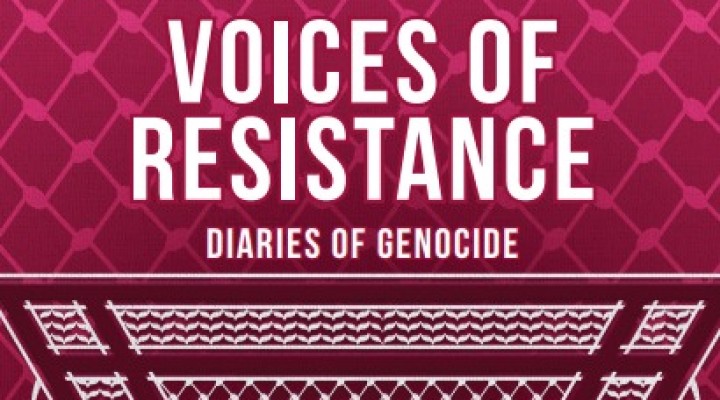

- Book Editor(s):Basma Ghalayani, James Harker, Ra Page
- Publisher:Fasila (Imprint of Comma Press)
- ISBN-13:781917093064
Voices of Resistance: Diaries of Genocide (Comma Press, 2025), presents the diary entries of four Palestinian women living through the genocide in Gaza. Spanning a time frame from October 2003 to March 2025, Batool Abu Akleen, Sondos Sabra, Nahil Mohama and Ala’a Obaid narrate their experiences, intertwined with those of other relatives and friends, and one cannot help but wonder, how does one live through genocide?
A recurring theme is adaptation, which explains how Palestinians live through genocide. The world becomes desensitised after a while, and Palestinians adapt. It is disconcerting to read, time and again, of Palestinians adapting to genocide as the only means of possible survival. “It scares me how well people adapt. It scares me that people can dress in the morning as if nothing happened,” Abu Akleen writes. “I, like them, have adapted.” The travesty of human rights couldn’t have been more clearly evoked.
“This is the Palestinian people in a nutshell: they grumble, then relocate, then they adapt,” Mohana writes, after describing the hardships of queuing for food rations, food planning, lack of hygiene, the repeated forced displacements. The discrepancy in the choice of words is also stark. Grumble in the face of genocide. Military might and international complicity versus a population rendered helpless by colonialism.
The diary entries provoke much pondering. Fear and death intertwine with nostalgia, and mundane conversation is not mundane at all. To speak of the mundane at a time of genocide is abominable. Yet most discussions revolve around practical matters of displacement, accommodation, martyrs, funerals, because Palestinians have been forced into this macabre spectacle of normalised reality.
There is a consciousness, however, of a different mundane from that of other people who have not lived through or experienced genocide. Mohanna writes of how she finds it impossible to relate to her friend’s troubles in Canada. “How do I tell her that the struggle of obtaining today’s bread, or receiving a feminine hygiene package, has become more important to me than her, her car, and our entire friendship?”
“My temporary neighbour knows all this and more,” Mohanna adds. “War doesn’t recognise history; it only recognises geography.” And once again, adaptation features albeit indirectly. Genocide changes friendships and forges new ones; the latter still perilous as annihilation is never a distant phenomenon.
The ongoing forced displacement is imparted through lived experiences. Abu Akleen notes that the wash hut in Deir Al-Balah was constructed out of material left by other displaced Palestinians. Displacement is also a journey accompanied by a few items of choice, which sometimes are determined by relevance. “Displacement is unique in its abruptness,” Sabra writes. “There’s no rehearsal, no preparation. You must let go of almost everything you cherish and set out of a path that’s jagged and desolate, as if you had never been tied to anything at all.”
Children also feature prominently in this collection of diary entries. “Alongside the alphabet of letters, we learn the alphabet of wars,” Sabra notes, as she narrates her own recollections as a child during the 2008 Israeli assault on Gaza known as Operation Cast Lead. She also tells of how her nephews and nieces were killed by Israeli missiles during the genocide: “Two days ago, on December 5, ‘terrorism’ was hiding in the body of Omar, my six-year-old nephew, perhaps in his heart, or maybe among his soft locks of hair.”
The definition of school has also been lost for Palestinians. Schools have become places of shelter which are bombed. For children, however, school and education take on a completely different meaning. Working with the Tamer Institute for Community Education, Mohanna writes that she was tasked with compiling “a special ‘children’s dictionary’ relating to the war.” She starts by asking how many times the children have been displaced. The last child to speak says, “I’ve lost count.”
Obaid’s diary entries are replete with experiences of repeated forced displacement and carnage after Israel’s bombing. A mother crying “I wish I hadn’t put her to bed early,” as she discovers her daughter’s body under the rubble. Safe routes are strewn with butchered bodies as Israel bombed convoys of Palestinians forced to evacuate from their homes, or perhaps from one displacement to another. Obaid gives birth during genocide, and is almost refused entry into a hospital because a pregnancy was no longer considered a matter of life and death, despite complications that can arise. Aft er her child is born, she becomes conscious of other women around her – one in unbearable pain praying for death to be reunited with her husband. Obaid wonders, “How many women in our country are having the children of men who died in this war?”
It is the matter of fact narrations in all entries that make this a deeply disturbing read. Between adapting and desensitisation – coercion and normalisation – what is next for Palestinians in Gaza?
https://www.middleeastmonitor.com/20250723-voices-of-resistance-diaries-of-genocide/

0 thoughts on “Voices of Resistance: Diaries of Genocide”