 TheAltWorld
 How Trump Is Helping Normalize Israel’s Settlements in the West Bank
- Ramona Wadi
- Wednesday 22 Apr 26
- 595
- 0
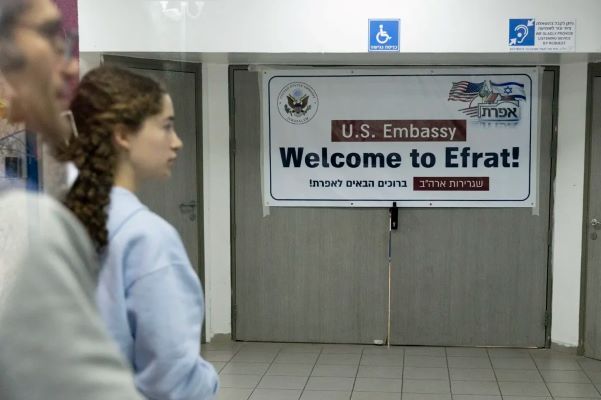
In February, the U.S. Embassy in Jerusalem announced it would provide consular services for American citizens living in Efrat, alongside numerous illegal and legalized settlements in the Occupied West Bank, including East Jerusalem. This marks a continuation of a trend spanning decades, in which Israeli settlement expansion has advanced alongside a gradual reshaping of international norms, with the United States playing a decisive role. Indeed, what was once widely recognized as a clear legal boundary has become increasingly indistinct amid the worst settler encroachments in the conflict’s history since Israel’s founding.
Ostensibly part of the Freedom 250 initiative commemorating U.S. independence, the U.S. embassy released a statement confirming that the one-day consular service opening would gradually extend beyond Efrat to other areas of the West Bank, alongside Beitar Illit, Haifa, Netanya and Beit Shemesh. Beitar Illit and Efrat are recognized as illegal settlements under international law. Around 4,000 settlers living in Efrat are U.S. citizens. Ramallah’s inclusion on the list as a Palestinian city is likely to lessen any negative response to the broader announcement.
Providing such services in illegal settlements blurs the line between what is recognized as legitimate under international law.
Before this announcement, U.S. citizens living in illegal settlements had to travel to Jerusalem for consular services. The reasoning was clear: Providing such services in illegal settlements blurs the line between what is recognized as legitimate under international law — Israel’s existence and expansion within pre-1967 boundaries — and the illegal settlement expansion beyond them on Occupied Palestinian Territory (OPT).
Both the Palestinian Authority (PA) and Hamas condemned the move. Hamas described the move as “a practical recognition of the legitimacy of colonial-settlements and the occupation’s control over the West Bank.” The PA’s Colonization and Wall Resistance Commission warned that the move, beyond reinforcing illegal settlement activity, risked treating “occupied territory as an administrative sphere open to diplomatic normalization.”
The U.S. announcement came a week after the Israeli Knesset approved a plan to designate Palestinian land in Area C of the West Bank as state land if ownership cannot be proven. The Israeli state has long used lawfare to slowly encroach on this area, designated as falling under full military control of the Israeli state per the 1993 Oslo Accords, which outlined a framework for a two-state solution. In this regard, the major obstacle facing Palestinians hoping to prove ownership of their land is the loss or destruction of documents dating back to the 1947-49 Nakba, when Israeli militias forcibly displaced Palestinians upon the creation of Israel. The same issue occurred after the 1967 Six-Day War and subsequent military occupation that has extended to today.
Mike Huckabee, the U.S. Ambassador to Israel who has claimed that Israel does not occupy Palestinian territory, recently suggested that it would be acceptable for Israel to take land stretching from Egypt to Iraq. The U.S. Embassy in Jerusalem later walked back his remarks in a statement: “If one listens to the full context, Ambassador Huckabee clearly says that Israel has no desire to change their current boundaries.” The statement and walk back, however, do not address the absence of defined borders constituting Israel’s colonial expansion, often framed by its proponents as “Greater Israel.”
Huckabee’s comments appear to contradict U.S. President Donald Trump’s stated opposition to annexation. However, Israel’s moves to appropriate Palestinian territory in Area C and the U.S. embassy’s decision to provide consular services in illegal settlements can be traced back to a series of unilateral decisions taken in the Trump administration’s first term, reflecting the longer arc of Palestinian dispossession.
In this regard, Trump’s 2017 unilateral recognition of Jerusalem as Israel’s capital reversed longstanding U.S. policy that its status should be determined through negotiations that produce a two-state solution. A year later, he relocated the U.S. Embassy from Tel Aviv to Jerusalem, citing the 1995 Jerusalem Embassy Act, which had not previously been implemented. The move came despite a U.N. General Assembly resolution in 2017 reaffirming global opposition to any changes in Jerusalem’s character, status or demography.
While the initiative currently targets Americans in illegal settlements, plans to expand services to both settlement areas and internationally recognized Israeli cities further complicate distinctions upheld in international law.
Then, in 2019, the United States recognized Israel’s sovereignty over the Syrian Golan Heights, which Israel has illegally occupied since 1967. That same year, U.S. Secretary of State Mike Pompeo reverted to the Reagan administration’s position that Israeli settlements were not inherently illegal, arguing, “The establishment of Israeli civilian settlements in the West Bank is not per se inconsistent with international law.”
Under Trump’s Peace to Prosperity Plan in January 2020, the U.S. explicitly endorsed annexation, proposing that Israel could claim sovereignty over 30% of the West Bank, including illegal Israeli settlements and most of the Jordan Valley. The 2020 signing of the Abraham Accords between Israel and the United Arab Emirates and Bahrain paused that plan. However, Israeli Prime Minister Benjamin Netanyahu described the annexation pause at the time as temporary. Similarly, as then-U.S. Ambassador to Israel David Friedman clarified, “We said in our statement that sovereignty will be postponed, and this does not mean that it has been abolished, but rather that it has stopped. It has been suspended for a year, maybe more, but it has not been canceled.”
A recent report by the Office of the U.N. High Commissioner for Human Rights found that between Nov. 1, 2024, and Oct. 31, 2025, Israeli officials intensified settlement expansion plans to alter the demographics of the West Bank and hinder the creation of a Palestinian state. In the reported period describing settlement expansion in the entirety of the occupied West Bank, including East Jerusalem, 27,200 and 36,973 housing units, respectively, were approved for construction in Israeli settlements “as part of plans for new settlements, settlement expansions or urban renewal of existing settlements.”
Each of these developments links back to the 1947 Partition Plan, however, which allocated 55% of historic Palestine to a Jewish state. Yet at the end of the Nakba, Israel controlled more than 78% of the territory. Normalizing ethnic cleansing through international institutions enabled Israel to expand with impunity while allowing the international community to differentiate between settlement expansion in 1948 and later efforts from 1967 onwards. This fragmented perception, amplified by turning a blind eye to settlement expansion, allows creeping annexation through bureaucratic means.
It is within this context that the U.S. decision to provide consular services in settlements builds on decades of legitimized colonial expansion. While the initiative currently targets Americans in illegal settlements, plans to expand services to both settlement areas and internationally recognized Israeli cities further complicate distinctions upheld in international law. This obfuscation reflects the earlier legitimization of territory seized during the Nakba, which overstepped the Partition Plan’s boundaries.
Although there remains a broad international consensus that post-1967 settlements are illegal, non-binding resolutions have failed to halt their expansion. The latest U.S. steps reflect that reality: Israel expands its presence on Palestinian land while the U.S. extends services to settler-colonists that are consolidating Israel’s presence. The subtle move may appear incremental, but it aligns closely with Israel’s annexation plans.
How Trump Is Helping Normalize Israel’s Settlements in the West Bank
EFRAT, WEST BANK – FEBRUARY 27: People arrive to receive consular services at the Jewish settlement of Efrat as the United States embassy in Israel begins providing “routine passport services” on February 27, 2026 in the Israeli settlement of Efrat in the occupied West Bank. The U.S. says it will provide similar services in another settlement, Beitar Illit, in the coming months. The outreach marks a break with several decades of U.S. policy toward the settlements, which much of the world considers illegal and built on land intended for a future Palestinian state.
Source: Photo by Amir Levy/Getty Images

Ramona Wadi
Ramona Wadi is an independent researcher, freelance journalist, book reviewer and blogger. Her writing covers a range of themes in relation to Palestine, Chile and Latin America.
0 thoughts on “How Trump Is Helping Normalize Israel’s Settlements in the West Bank”