 TheAltWorld
 The De Facto Restoration Of South Yemen Drastically Shifts The Conflict’s Dynamics
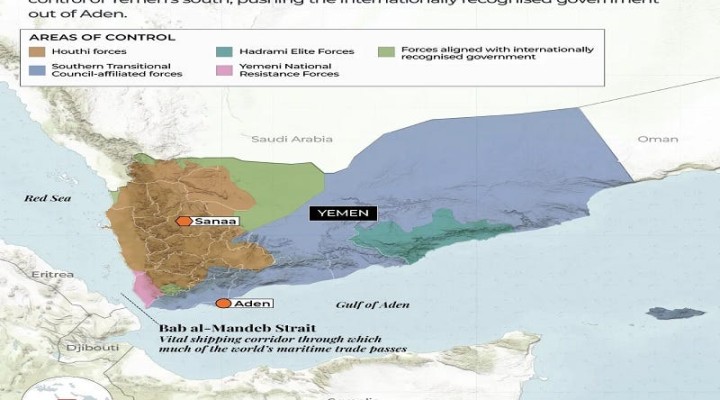
The Southern Transitional Council made pivotal progress on restoring South Yemeni sovereignty, which could lead to Yemen’s re-bifurcation into separate North and South states as a pragmatic compromise for ending this protracted conflict in which neither side is capable of achieving their maximalist goals.
Local allies of the UAE-backed Southern Transitional Council (STC), which aspires to restore South Yemen’s sovereignty and whose President Aidarus al-Zoubaidi is the Vice-President of Yemen’s Presidential Leadership Council (PLC), took control of the eastern governorates of Hadhramout and Mahrah in early December. This averted Yemen’s trifurcation that was described here in March 2023 as regards its split into the Houthi-controlled North, the STC-controlled South, and the Saudi-swaying East.
The trigger event was Hahdrami tribal leaders announcing their plans to take control of the province’s oil fields, Yemen’s largest, and politically manage their own affairs. The STC therefore foiled a Saudi power play aimed at either laying the basis for an autonomous client state, a nominally independent one, or the Kingdom’s newest region one day. Likewise, a restored South Yemen would now be economically viable with these oil fields under the STC’s control, thus making a redeclaration of independence more likely.
The STC also established full control over Aden throughout the course of the latest events. That coastal city used to serve as South Yemen’s capital but now hosts the PLC while the national capital Sanaa remains under Houthi control. PLC Chairman Rashad al-Alimi, other PLC figures, and Prime Minister Salem Saleh bin Braik fled Aden for the Saudi capital of Riyadh where Alimi lambasted the STC. President Zoubaidi didn’t take the bait, however, and instead praised the Saudi-led coalition against the Houthis.
According to the STC, he also “reaffirmed that the South, which stood loyal in 2015, is today even more loyal, stronger, and more prepared to be the spearhead of the Arab project to cut off Iran’s arm in the region and end the Houthi threat to international shipping and neighbouring countries.” Strengthening the South through the latest operation, he said, “is not an end in itself but rather the cornerstone and true starting point for any serious battle to liberate the North from the brutality of the Houthis.”
His words are sincere since the STC and the Houthis are sworn enemies, but they’re also meant to reassure the Saudis that the STC isn’t against them. Cooperating with the STC against the Houthis is still in their interests despite their ego being bruised by this Emirati-backed group dislodging their political clients from Yemen. Even in the best-case scenario of close coordination between them, however, the odds of a full-fledged joint offensive against the Houthis anytime soon – or perhaps ever again – is low.
For as powerful as the STC has become, it’ll still struggle to defeat the deeply entrenched Houthis in their Northern mountainous strongholds, and a resumption of Saudi air strikes against their shared enemy in support of any ground campaign is unlikely since Riyadh doesn’t want a return to all-out war. Past Houthi drone and missile attacks shook the Kingdom to its core and it’s loath to have that happen again. The US doesn’t want to resume its prior failed campaign either, nor does Israel, so nothing serious is expected.
The most likely outcome is therefore that the STC consolidates its control over South Yemen in the face of probable non-kinetic pressure from the Saudis (e.g. economic coercion and information warfare) to share power with the self-exiled PLC. The STC doesn’t want the strong enemy state of Houthi-controlled North Yemen on its borders, but it might be forced by circumstances into accepting this as a possible compromise for restoring South Yemen’s independence. That might not happen for some time, though.

https://korybko.substack.com/p/the-de-facto-restoration-of-south

3 thoughts on “The De Facto Restoration Of South Yemen Drastically Shifts The Conflict’s Dynamics”