 TheAltWorld
 South Korea Will Remain A Key Part Of The US’ Chinese Containment Plans
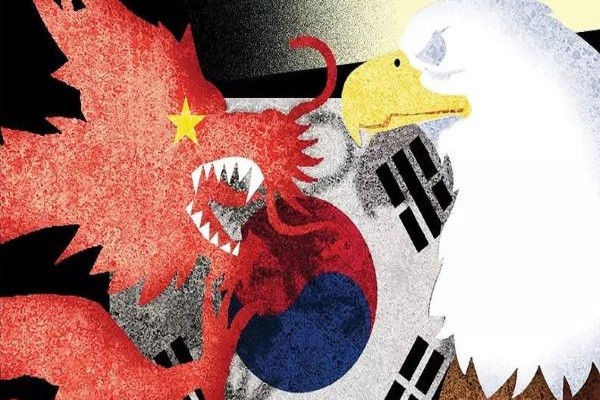
The Sino-Russo Entente might evolve into a de facto alliance if South Korea and Japan join AUKUS+, the US’ de facto “Asian NATO”, but that risks spooking India into a de facto alliance with the US to counterbalance perceived Chinese influence over Russia and thus further destabilizing Eurasia.
Trump’s meeting with Xi prompted hopes that progress might be made on managing Sino-US tensions, but many of these same observers missed the meeting that took place in DC earlier in the week between the American and South Korean (ROK) Defense Ministers, which casts doubts on these hopes. Part of the agenda concerned the deal that was reached during Trump’s visit last year for the US to help the ROK build a nuclear-powered submarine, which was assessed here as facilitating its integration into AUKUS+.
China strongly objected to 2021’s AUKUS pact by which the UK and the US agreed to help Australia develop a nuclear-powered submarine fleet. While China’s reaction to the ROK’s similar such deal with the US last year was relatively more muted due to recently improved bilateral ties, its threat assessment is presumably even higher due to the ROK being much closer to China than Australia is. It also represents the deepening of the US’ military-strategic influence that could be exploited for containment purposes.
Not only would South Korea likely integrate into the US’ AUKUS-centric regional military network that informally involves Japan, the Philippines, and even Taiwan, but China’s rival Japan already signaled interest in clinching its own nuclear-powered submarine deal with the US. Given that the ROK and Japan are “frenemies” for reasons beyond the scope of this analysis to explain, it’s possible that the US will decide to reach a parallel agreement with Japan, thus intensifying China’s threat perception of AUKUS+.
To make matters worse, the US’ nuclear-powered submarine cooperation with the ROK (and potentially soon Japan too) could easily evolve into nuclear weapons cooperation, which is a credible scenario after the expiry of the New START per Trump 2.0’s wishes raised the risk of a global nuclear arms race. The ROK and Japan both have what’s known as nuclear latency, or the ability to build nukes if the decision is made, which over 75% of South Koreans support but over 60% of Japanese oppose.
Under Secretary of War for Policy Elbridge Colby earlier declared that the US would “strenuously oppose” more European countries developing nukes, possibly for escalation-control purposes vis-à-vis Russia, so the same calculation vis-à-vis China might be applied towards East Asia. Nevertheless, such calculations could always change, and the US might also secretly support such programs or at least turn a blind eye towards France and/or the UK aiding them. China therefore has a reason to be concerned.
At the very least, the US is expected to wield the scenario of the ROK and/or Japan going nuclear as a Damocles’ sword over China in a bid to deter it from reciprocally escalating Sino-US tensions amidst the inevitable consolidation of AUKUS+, the de facto “Asian NATO”. Seeing as how the US will thus continue containing China even in the event of a major trade deal, China might become more receptive to Russian hardliners’ proposals to comprehensively deepen cooperation, thus forming a de facto alliance.
The trade-off is that India might then be spooked into consolidating its close military ties with the US into the same due to fear of China becoming Russia’s senior partner and then coercing it into cutting off arms and spares to India, which would enable China to blackmail India amidst their border disputes. This tit-for-tat alliance sequence catalyzed by AUKUS+ could further destabilize Eurasia, facilitate the US’ divide-and-rule plots, and make Sino-US bi-multipolarity inevitable, but it also can’t be ruled out either.
https://korybko.substack.com/p/south-korea-will-remain-a-key-part

3 thoughts on “South Korea Will Remain A Key Part Of The US’ Chinese Containment Plans”