 TheAltWorld
 Exclusive: Iran – Pakistan, what is really happening in the diplomatic front
The Bab al-Mandab is not closed. It is loaded.
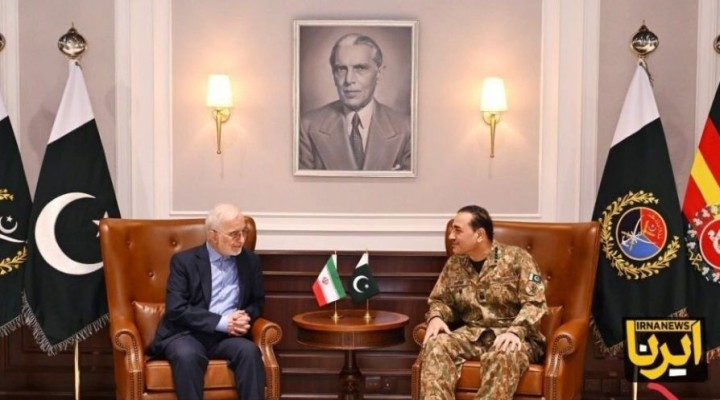
Earlier this week, Iranian Interior Minister Eskandar Momeni arrived in Islamabad leading a substantial delegation. By Tuesday, he had met Prime Minister Shehbaz Sharif, Field Marshal Asim Munir and his Pakistani counterpart, Mohsin Naqvi.
This was far from a routine border/security visit involving two neighbors. The key take away was the presence of the head of the National Iranian Oil Company (NIOC): that means that energy – as in the possible construction, finally, of the Iran-Pakistan (IP) gas pipeline – sanctions and cross-border trade were crucial items in the menu.
Now for the clincher. Momeni carried a special message from the Iranian leadership about the war. The Pakistanis went out of their way to say publicly that the Iranian delegation had arrived with “good news.”
The question is how these “good news” were presented.
Before Momeni landed in Islamabad, Pakistan’s leadership – civilian and military – was informed that he was hand carrying a letter from Leader Mojtaba Khamenei.
Yet after he arrived, Momeni informed the Pakistanis that he did not carry an actual letter; but he did bring a message from Mojtaba to the Pakistani leadership, fully supported by President Pezeshkian and Foreign Minister Araghchi.
The message covered many key issues of the Iran-Pakistan relationship and also the mediation by Pakistan between Tehran and the Trump presidency.
According to the message, Iran would consider accepting a 10-day pause on the current escalation ladder. But for that to happen Trump needs to start delivering the very moment Iran accepts the 10-day pause on all (italics mine) aspects of the 14-point Memorandum of Understanding (MoU).
Translation: no new negotiations. This, incidentally, happens to also be the Chinese position. The only thing that matters is to go back to the original MoU and fulfill its commitments.
Predictably, Trump rejected what was in the message, and Iran was informed by Pakistan of Trump’s refusal to take the only off- ramp available to him. And this, according to the mediators, after the narcissistic megalomaniac had pestered Asim Munir with daily phone calls begging Munir to find this exact off-ramp.
Was there a message? And how was it delivered?
Now for the complicating factors. Top sources in Tehran are adamant on three points.
- Leader Mojtaba Khamenei did not send any message to Pakistan, nor is he in touch with anyone in Pakistan, including Asim Munir.
- If he had sent a message, it would not have been via a minister. It’s usually via the President (Pezeshkian), the head of Parliament (Ghalibaf) or the secretary of the Supreme National Security Council (Zolghadr), as it happened previously with China and Russia.
- This information about a 10-day pause, and then a further 60-90 days is false and unrealistic. Iran does not and won’t negotiate on this matter.
Well, it’s a fact that Iran has many competing power structures at work in Tehran. So divergences may happen on procedure, all the time. And on what should be admitted publicly. The point is Pakistanis would have zero incentive to fabricate such information, knowing it would be instantly unmasked by the Iranians.
We should look at the facts. President Pezeshkian has publicly made clear, in several occasions, that Mojtaba is the final authority in Iran; that major moves are being taken under his guidance; and that the leadership wants to end the present, dangerous state of things, “neither war nor peace.”
So it’s plausible to consider that the message came from the highest level of the Iranian state and carried Mojtaba’s authority and approval. But should have remained in the shade. The fact that Trump rejected it makes it even more plausible.
Once again: even as Iran is running the clock, the leadership is also perfectly aware that time is running out for Trump. It’s a consensus in Tehran that the nation can continue absorbing tremendous economic and military pressure while raising the wider cost of the war via its control of the Strait of Hormuz – and now with another vector entering the picture: the Yemeni naval blockade of Saudi Arabia in the Red Sea.
Tehran’s calculus is crystal clear. With the escalation ladder on,
the politico-economic pressure is already spreading like wildfire across West Asia, shipping lanes and global energy markets.
So Iran’s message to Trump, relayed indirectly by the Pakistanis, in fact remains the same: implement the original 14-point MoU in full and without renegotiation; or be ready for a prolonged war and non-stop disruption of energy and maritime transit, with devastating consequences.
How the message was delivered to Trump, via Islamabad, is not the main issue. The extra fine layer is that the trade, pipeline and border discussions were used as a cool diplomatic cover for delivering Tehran’s terms for ending the war.
And the key point remains the same: for Tehran – as well as for Beijing – the MoU is the real deal. A completed agreement. Washington must implement it. Because there won’t be another round of negotiations.
The consequences of Iran holding total leverage
The Saudi-Yemen drama remains in suspense. Pakistani mediators are adamant: Islamabad told Riyadh to stand down, because the last thing it needs right now is to be forced to enter the war as a participant, not as a mediator.
There’s no “instruction” being awaited by Sana’a to go further on the Bab al-Mandab. That’s trademark Western news agency blah blah blah. What Ansarallah did was to counter the Saudi blockade on Yemen lasting over 11 years. The principle is “a siege for a siege”. And this siege applies only to Saudi Arabia. The Bab al-Mandab will be blocked for good, for everyone, only if and when the US attacks Iran’s electrical grid and power infrastructure.
So the Bab al-Mandab is not closed. It is loaded.
The larger strategic reality is undisputable. Iran now holds total leverage over two of the world’s most important energy chokepoints.
Meanwhile, Iran is methodically forcing the Empire of Piracy to become deaf, dumb and blind across the Persian Gulf spectrum, destroying Patriot batteries, radar installations, refueling stations and assorted military infrastructure across Kuwait, Bahrain, Jordan, Qatar and Oman.
Kuwait is desperately trying to clinch a defense arrangement with Pakistan modeled on the existing Saudi framework. That would potentially involve Pakistani troops, aircraft, drones and air-defense capabilities in return for energy and, of course, lots of money. Saudi Arabia is encouraging Kuwait to go for it.
There’s even serious discussions of a wider Turkiye-Pakistan-Saudi mutual-defense framework. It will be a Sisyphean task to convince Tehran this won’t be another anti-Iran ploy.
Still, the fact is a significant part of the Persian Gulf is beginning to hedge away from exclusive security dependence on the Empire of Piracy, looking for a non-American security guarantee. Pakistan is now in the position to decide how far it’s prepared to go. Without sacrificing those painfully constructed good relations – encouraged by China – with neighborly Iran.
Exclusive: Iran – Pakistan, what is really happening in the diplomatic front

0 thoughts on “Exclusive: Iran – Pakistan, what is really happening in the diplomatic front”