 TheAltWorld
 The US War on Iran Continues
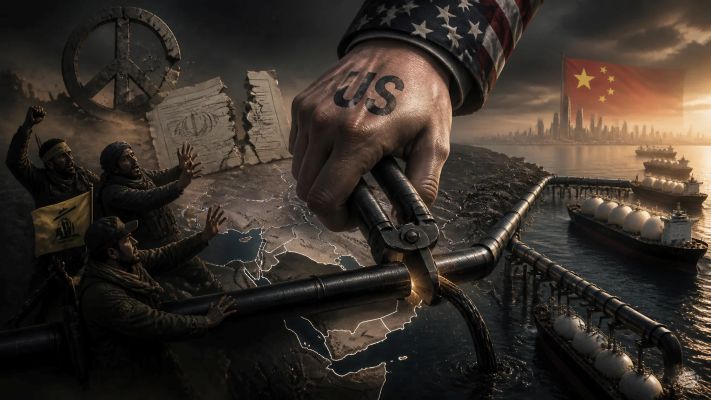
The US continues to playact diplomacy with Iran regarding the latest “memorandum of understanding” (MOU) signed, then immediately violated by the US, renegotiated, and supposedly agreed upon again — using the pause in all-out war to carefully shape the battlefield ahead of what will inevitably be another round of large-scale aggression.
This process takes place within the context of US policy papers for years, admitting that diplomacy in and of itself would be used against Iran to create a pretext for war rather than be used as a means of preventing it.
The US has implemented precisely this policy through multiple instances of the US deliberately betraying diplomatic processes, including the violation of the so-called “Nuclear Deal” (Joint Comprehensive Plan of Action or JCPOA) and two back-to-back US decapitation strikes carried out in the middle of US-Iranian “negotiations” between 2025 and 2026.
These most recent chapters of US duplicity follow decades of war aimed at West Asia, imposing US domination over the region and slowly encircling and isolating Iran — both through interference, terrorism, and military aggression aimed at Iran itself, as well as at Iran’s network of allies.
US policy papers have long noted Iran’s regional network of allies as key to its national security policy, even specifically describing it in terms of defensive and retaliatory capabilities.
One such paper, the RAND Corporation’s 2009 “Dangerous But Not Omnipotent: Exploring the Reach and Limitations of Iranian Power in the Middle East,” under a section titled “Iran Pursues a Multifaceted Regional Strategy Marked by Strengths and Limitations,” explains:
“Iran fields a weak conventional force. Iranian leaders have long trumpeted their shift to an asymmetric strategy of homeland defense that would exact intolerable costs from an invader. Much of this rests on notions of “mosaic defense,” partisan warfare, and popular mobilization of Basiji auxiliaries.”
And that:
“Iran has limited leverage over so-called proxy groups. To compensate for its conventional inferiority, Iran has long provided financial and military support to a variety of non-state Islamist groups. According to Revolutionary Guard doctrine, this “peripheral strategy” is intended to give strategic depth to Iran’s homeland defense, taking the fight deep into the enemy’s camp. In the cases of Hamas and Hezbollah, this strategy also buys Iran legitimacy among Arab publics who are frustrated with their regimes’ seemingly status quo approach. In effect, Tehran is being “more Arab than the Arabs” on issues such as Palestine.
In supporting major Shi’ite militant groups in Iraq and Lebanon, Tehran may expect a degree of reciprocity. This is particularly the case in the event of a U.S. strike, in which Iran might expect these groups to act unflinchingly as retaliatory agents.”
Thus, US policymakers are fully aware that Iranian support for organizations like Hezbollah in Lebanon, Ansar Allah in Yemen, or the Popular Mobilization Forces in Iraq is defensive in nature rather than an irrational, aggressive, expansionist policy of coercion or even “terrorism” as US political theater depicts it amid the process of selling US wars of aggression against Iran to the American and wider global public.
This also means that US policymakers are keenly aware that in order to isolate and undermine Iran itself, it needs to undermine or completely eliminate this strategic depth Iran has created across the region first.
And this is precisely what has driven US policy in the region regarding Iran for at least the past 26 years, including US war, occupation, and proxy war in Lebanon, Yemen, and Iraq, as well as Syria.
It is also at the heart of continued aggression against Iran—mistaken by many as a “failed regime change” war, is instead the continued chipping away of Iran and its network of alliances in the region, all while advancing US policies far beyond the region.
Throughout the 21st century, the US has either attacked these Iranian allies directly or through its network of proxies in the region, including Israel and extremist groups, via Washington’s Persian Gulf and Turkish proxies. The US-backed war of aggression by Israel against Lebanon in 2006 and the renewed invasion this year bookend the war waged against Yemen with mixed results and the final toppling of Iran’s close ally, Syria, in 2024.
A look at a map of the region from 2000 to 2026 shows the US slowly enveloping and eliminating Iran’s alliance network and now waging direct war against Iran itself.
This reality is likely why Iran insisted any ceasefire between the US and Iran must also include ceasefires against Iran’s network of allies in the region — specifically Hezbollah in Lebanon. This is also likely why when the US, through Israel, continued waging a war of aggression against Hezbollah in Lebanon, Iran suspended elements of the MOU.
Anything less would equate to providing the US with a frozen front against Iran — allowing the US to rearm and reorganize its forces and strategies — while continuing to erode Iran’s regional asymmetric defense strategy, ultimately giving the US an additional advantage ahead of what is inevitable, larger-scale hostilities provoked by the US against Iran in the near to intermediate future.
Playacting for Peace While Managing Malicious War
At face value, the notion of the US making demands of Iran in the first place runs contrary to international law. The US — located in North America in the Northern/Western hemispheres — thousands of kilometers from Iran and West Asia (also referred to as the Middle East) — has no legitimate interests or “national security” concerns in West Asia or regarding Iran.
Boasts that the US is “energy independent” only further undermine any claim by the US that West Asia’s affairs somehow translate into legitimate US interests.
Claims that Iran has targeted and killed Americans for “47 years” omit the fact that those Americans were US military forces operating closer to Iran than the US’ own shores amid serial illegal invasions, occupations, and other unprovoked, indefensible military interventions in the region.
As with all US pretexts for launching illegal wars of aggression, the actual “evidence” Iran was responsible for these attacks is threadbare.
Similarly, claims that “Iran” was behind a supposed assassination attempt on US President Donald Trump himself are likewise baseless — predicated on claims by the supposed suspect that Iran directed him to carry out the attempt — but no actual evidence exists suggesting these claims are true.
Mirroring the US sanctioning, undermining, subversion, and eventual invasion and occupation of Iraq, likewise predicated on now admittedly and deliberately false pretexts, the US seeks to expand its unwarranted illegal occupation and control of West Asia — half a world away from America’s own shores — with little effort to mask the true purpose for doing so.
While US politicians and policymakers repeat claims of Iran “killing” Americans and pursuing “nuclear weapons,” there have been increasing public admissions that subordinating or toppling Iran directly serves the US goal of encircling and containing China as well as dismantling the multipolar world order China and its allies propose as an alternative to the current US-dominated unipolar world order.
Beyond Iran and West Asia: Energy Dominance Over Asia
Control of West Asia would allow the US to throttle energy exports to both China and the rest of Asia, placing pressure on China to scramble to replace up to half of its total energy imports and place the rest of Asia under increased energy dependence on the US itself.
Under the teetering MOU, the US has lifted its own blockade of Iranian ports and is supposedly lifting sanctions on Iranian energy exports. While it is tempting to interpret this as a “retreat” from blockading China and the rest of Asia, it should be pointed out that between 18-20% of all energy production in the Persian Gulf has been disrupted or destroyed by the US war of aggression on Iran, requiring weeks, months, and in some cases a year or more to bring back online.
This alone will continue to feed the growing energy crisis precipitated by the February 2026 US war even if all aspects of the current MOU are upheld. At any moment of Washington’s choosing, it itself or through its Israeli proxies can reignite hostilities, striking at and undo any progress made in bringing that 18-20% disrupted or destroyed energy production back online, or incur even greater region-wide disruptions or destruction.
The US — while announcing a drawdown of its own blockade on Iranian ports — continues to disrupt maritime shipping elsewhere around the globe through a blockade on Cuba and continued interdiction operations targeting Russian energy exports via European naval operations as well as maritime drone strikes on Russian ships attributed to Ukraine but admitted by the New York Times to be organized and overseen by the US intelligence community and military.
Again — at any time of Washington’s choosing — Iranian maritime shipping can be targeted and disrupted again, either at similar levels as before or at an even more aggressive level than previously this year.
The US demonstrated the ability to not only seize ships anywhere between the Strait of Hormuz in the Persian Gulf and the Strait of Malacca in the Asia-Pacific, but also the ability to target and disable ships using anti-shipping missiles fired by US warships and missiles fired by US warplanes operating across the region, but just beyond the reach of Iran’s anti-air and anti-ship capabilities. Should the US desire to do so, it could simply expand the number of ships it targets and disables even if it lacks the ability to expand the number of ships it seizes with boarding parties.
Managing the level at which the US disrupted or destroyed energy production across the region or maritime shipping of energy out of the region was pivotal in managing market prices and the emerging economic crisis the US deliberately precipitated with its war of aggression. The US created enough disruption to force nations across Asia to sign long-term contracts for US LNG exports otherwise inexplicably built up over recent years for demand that didn’t yet exist.
Some of these projects even cited “contested waterways” as a selling point as recently as 2025, despite the Strait of Hormuz only being threatened and closed as of 2026.
But the US stopped short of creating a catastrophic collapse or crisis that would prompt nations into taking emergency measures that might enable them to protect themselves not only against the disruption of energy exports from West Asia, but also America’s attempts to exploit them.
Thus, the US is conducting a “controlled demolition” of both West Asia’s capacity to supply Asia with energy and the economies of Asia depending on this energy, causing enough damage to gradually shift dependency away from West Asia and toward the US, without triggering a unified front against the US itself and its upending of global stability.
If the US Can’t Rise to Meet the Multipolar World, It will Drag it Down to Its Level
While many analysts point out correctly the US has nowhere near enough energy production capacity to replace West Asia’s energy exports — just as it has nowhere near enough energy to meet all of Europe’s needs — reducing overall access to energy for both Europe and Asia and the subsequent deindustrialization that is following fulfills Washington’s most immediate challenge: how to maintain primacy over a world rapidly outpacing the US in terms of industry, innovation, and military power.
By throttling access to energy for Europe, Asia, and other regions of the world, the US is hoping to create artificial energy scarcity, triggering an inevitable process of economic reversal, deindustrialization, and overall geopolitical anemia worldwide.
The US is incapable of competing with just China alone head-to-head fairly and in open markets, falling behind in virtually all metrics despite aggressive tariffs, sanctions, bans, and information operations all aimed at giving the US an advantage over China. Its ability to compete and maintain dominance over the entire world — all factors being equal — is a fantasy.
Thus, more aggressive means are being pursued — means by which past empires have likewise maintained hegemony over vastly larger geographical regions and populations — through dividing and weakening others, thus avoiding the necessity of competition altogether.
As long as the rising multipolar world continues allowing the US to target and undermine nations one-by-one without creating a unified front against the disruptive, predatory geopolitics of the US, the US will continue to successfully manage the size and power of the multipolar world and eventually isolate and contain the core nations driving its nascent emergence in the first place.
The US depends on the fact that no single nation — except perhaps China — can challenge the US.
As long as the US maintains its subversion, coercion, and aggression just below the threshold of posing a global threat – focusing on individual states while carefully avoiding escalation with others — the nations of the world will fall short of the unified effort required to fully and finally neutralize the threat US pursuit of primacy poses to the world collectively.
It is possible that — just as with empires in previous centuries — the ruling interests of the world’s nations are too short-sighted and self-serving to cooperate sufficiently to displace US dominance — short of the US creating an obvious and omnipresent threat to all of these nations simultaneously.
The result is a US that will continue to enjoy dominance simply because of insufficient action by the collective world.
Only time will tell if the rest of the world is prepared for the effort and energy required for this transition, or if complacency and short-sightedness prevail, allowing the US to persist in its pursuit of power and profit at the cost of not only the world abroad, but also the vast majority of Americans at home. Iran is only one of several metrics indicating the vector sum of this overall struggle — with Iran’s ability to weather US aggression and confound US ambitions in West Asia signalling multipolarism’s expanse — or the persistence of US primacy in West Asia and its ability to disrupt the rest of the world because of it, signalling multipolarism’s current limits.
https://journal-neo.su/2026/07/03/the-us-war-on-iran-continues/

2 thoughts on “The US War on Iran Continues”