 TheAltWorld
 ‘Iran is NOT an integrated part of the Western financial system’ – Catherine Austin Fitts
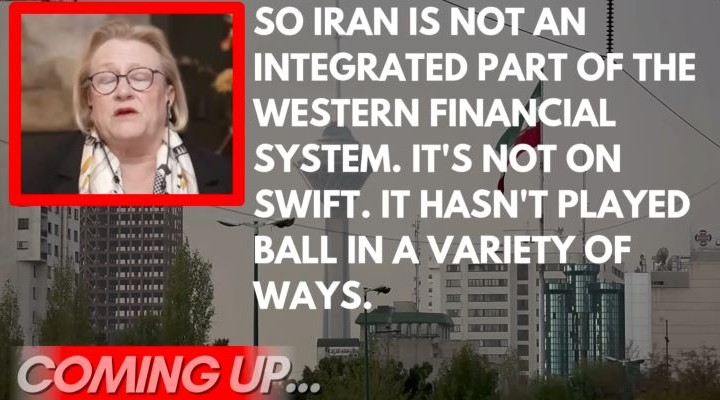
Many have blinded themselves to the reason that Iran was last on the list of the 7 countries targeted for destruction by American-led Global Capitalism
The above screenshot comes from this Catherine Austin Fitts interview with CapitalCosm on YouTube.
I am also republishing sections of an article by Ellen Brown that reinforces much of what I have been saying, on recent interviews, about the Iranian financial system and how the US is attempting to destroy yet another example of usury-free independent banking in the West Asia region.
Ellen Brown is an attorney, founder of the Public Banking Institute, and author of thirteen books including Web of Debt, The Public Bank Solution, and Banking on the People: Democratizing Money in the Digital Age. Her 400+ blog articles are posted at EllenBrown.com.
She is a Research Associate of the Centre for Research on Globalization (CRG).
This article was published at Global Research and republished by Michel Chossudovsky at his Substack.
Excerpts below with some emphasis from me:
Full-Spectrum Financial Dominance
Other commentators point to the report of the Project for the New American Century (PNAC) titled “Rebuilding America’s Defenses” (September 2000), which called for “full-spectrum” U.S. military forces to achieve global preeminence. It postulated the need for a “catastrophic and catalyzing event — like a new Pearl Harbor” to accelerate the military transformation the authors envisioned.
This was followed by a 2007 Democracy Now interview in which Gen. Wesley Clark revealed that weeks after 9/11, he had been shown a classified Pentagon memo outlining plans to “take out seven countries in five years”: Iraq, Syria, Lebanon, Libya, Somalia, Sudan, and finishing off with Iran. The first six have since been destabilized or regime-changed. Iran, considered the ultimate prize for Middle East dominance and oil control, remains the last one standing.
Why those seven, and why was Iran the ultimate prize? Greg Palast’s 2013 article titled “Larry Summers and the Secret ‘End-Game’ Memo” supplied the missing financial logic. In 1999, the world was opened to unregulated derivatives trading, so that sovereign bonds, oil flows, shipping routes, and war-risk policies could all be collateralized, rehypothecated (pledged multiple times over), and gambled upon. The lynchpin was the 1997 WTO Financial Services Agreement (the Fifth Protocol to GATS), which became operational in 1999.
None of the seven targeted countries joined the WTO, and they were also not members of the Bank for International Settlements (BIS). That left them outside the long regulatory arm of the central bankers’ central bank in Switzerland. Other countries that were later identified as “rogue states” were also not members of the BIS, including North Korea, Cuba, and Afghanistan.
As for Iran, it is not only the largest and strongest of the Islamic countries but operates the world’s only fully interest-free (riba-free) banking regime. This stands in direct contrast to the conventional Western model, which relies on interest as its primary revenue mechanism. “Money making money out of itself” underpins the global derivatives complex, which is built on rehypothecated, collateralized debt-at-interest.
The last piece in the financial control grid was detailed in David Rogers Webb’s 2024 book The Great Taking. The Everything Bubble, including what some commentators estimate to be more than a quadrillion dollars in derivative bets, is just waiting for a pin. When it bursts, it will trigger large institutional bankruptcies; and under the legal machinery Webb documents, the derivative players will take all.
[…]
Iran’s Interest-Free Islamic Banking: The Structural Obstacle
So what did it matter if Iran and a handful of other countries declined to join in this lucrative bankers’ game? The risk was that when depositors and shareholders realized that they did not actually own their funds, they would move their assets to those safe zones. The holdout countries were also safe from the sort of sanctions imposed by Western governments (and enforced by Western banks and clearing houses) on Russian central bank assets after Russia’s invasion of Ukraine in 2022.
Leading this band of holdouts was Iran, which since its 1983 Law for Usury-Free Banking Operations has run the world’s only fully interest-free (riba-free) banking regime. Its banks use Sharia-compliant contracts — profit-sharing (musharakah), cost-plus financing (murabaha), and leasing (ijara) — instead of charging or paying interest. This banking model stands in direct contrast to the conventional Western model, which relies on interest as its primary revenue stream and underpins the global derivatives complex with collateralized, rehypothecated debt.
Iran’s system was designed to eliminate usury and align finance with real economic activity and risk-sharing rather than speculative debt. It has long been viewed as structurally incompatible with the interest-based, collateral-heavy architecture of City of London and Wall Street finance — an architecture that requires perpetual debt servicing and easily rehypothecated assets to feed the derivatives machine.
By rejecting interest at the national level, Iran has thus insulated itself and its financial partners from the control grid that has made the global “Great Taking” possible.
You can read the full article here.
https://beeley.substack.com/p/iran-is-not-an-integrated-part-of

0 thoughts on “‘Iran is NOT an integrated part of the Western financial system’ – Catherine Austin Fitts”