 TheAltWorld
 Plots and Deeds: Agrarian Annihilation and the Struggle for Land Justice in Palestine
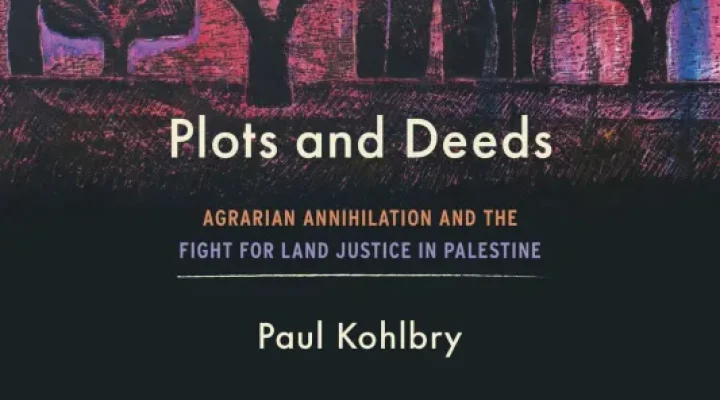

- Book Author(s):Paul Kohlbry
- Published Date:2026
- Publisher:Stanford University Press
- Paperback:262 pages
- ISBN-13:9781503645110
Rural Palestine stands between idealised and romanticised images of abundant land, and the reality of settler violence and the effects on agricultural territory. Plots and Deeds: Agrarian Annihilation and the Struggle for Land Justice in Palestine (Stanford University Press, 2026) asks, “What might we learn from rural Palestine if we understand the people living there not as an inert feature of the landscape, but as a force that is actively shaping it?” Focusing on three villages in the occupied West Bank, Bruqin, Farkha and Qarawat Beni Zays, Paul Kohlbry’s research explores the dynamics of land defence in the Palestinian anti-colonial struggle against settler-colonial dispossession and capitalist real estate development.
The three villages are described as locations “where property ownership and peasant labour are a living part of emerging collective identities, dynamic agrarian projects, and contested land and defence politics.” At odds with the Palestinian Authority’s neoliberal politics, Kohlbry notes that while foreign funding for building the Palestinian state created a divide between Ramallah and the agricultural villages, the importance of the Palestinian peasant in the Palestinian anti-colonial struggle cannot be ignored, with a history that dates back to the resistance against the British Mandate, long before Israel was established, and in its aftermath. The Nakba hastened agrarian dispossession in 1948, and the Galilee was the centre of Palestinian resistance against state expropriations of territory.
Kohlbry notes that through his fieldwork in Bruqin, Farkha and Qarawat Beni Zays, research on Palestine revealed some gaps, particularly regarding the transformation of land ownership and agrarian annihilation; the effects of which ripple throughout the villages. Thus, the ramifications of land appropriation in one area are not geographically restricted, but create a reaction which impacts other villages. Besides settler-colonial expansion, land as capitalist commodity for Palestinian developers has also impacted both dispossession and devaluation of agricultural land. As real estate development encroaches upon agricultural territory, Palestinian peasants face dispossession and unviable living situations.
Palestinians face various forms of dispossession, one of which is Israeli settlers and the army destroying agricultural land, as a Palestinian peasant from Bruqin told the author In Farkha, a farmer remarked about how farming does not support families’ livelihoods anymore, and the realities of children moving elsewhere in Palestine for work. The result is not just sociological but also ecological, as settler destruction, the contamination of soil, and the neglect of agricultural land as a result all contribute to the disappearance of territory and ownership.
Each chapter in the book deals with a specific theme regarding agrarian annihilation, all of which are linked to the concept and reality of the Palestinian demand to return. As the book progresses, discussing in detail the different struggles of the Palestinian peasant which are much overlooked in the broader framework of the Palestinian anti-colonial struggle, Kohlbry states, “land justice is fundamentally a demand for return – both the return of the land that was taken, and a return to the land – that emerges from ordinary practices and small experiments that are transforming agrarian life.”
Land defence, Kohlbry states, “encompasses the various ways that Indigenous peoples resist colonial dispossession and displacement through asserting their political authority, legal control, and historical presence in specific territories.” While colonialism painted Palestinian peasant culture as backward to justify settlement expansion, Palestinian nationalism associated the peasant with sumud. For Palestinian peasants, however, the presence is tied to the land. In the case of absence, the land is tied to the Palestinian return. Return, in the case of the Palestinian peasant, is tied to “the renovation of agrarian ethics, knowledge and labour to create claims to the land, and to defend a collective Palestinian presence upon it.”
Land defence also has to contend with neoliberalism from Palestinians. Rawabi is mentioned as the prime example of land appropriation by Palestinians, but the author notes that other smaller Palestinian companies are purchasing Palestinian land for real estate investment and development, which contributes to the dispossession of the Palestinian peasant. Another obstacle was the incorporation of the Palestinian workforce into Israel, which left less time for agriculture and contributed to alienation especially among the younger generations.
What Kohlbry emphasises in his book is that while the dispossession of the 1948 Nakba remains the prime example of forced displacement, the loss that the current communities are suffering as a result of Israeli colonialism and expansion, neoliberal and capitalist politics need to be seen as an ongoing force of destruction of Palestine’s agrarian land. Return is usually thought of in terms of a return from exile, Kohlbry states, but in the occupied West Bank, return takes on a different dimension for Palestinians, as loss of land was not the outcome of dispossession similar to the Nakba. Rather, dispossession followed a trajectory of different forms of exploitation that pushed the peasant out, or away, from a land that once symbolised both livelihood and presence.
Drawing upon the Palestinian peasants’ resistance in the villages mentioned, Kohlbry notes that Palestinians embarked upon collective action to transform agrarian land, such as reclamation by faring, boycotts, farming committees. However, the Oslo Accords of 1993 hindered mass mobilisation, as did settlement expansion upon Palestinian territory.
The author notes, “The people who live in these villages face colonial powers that dispossess them, economic forces that price them out, political schemes that ignore then and ideologies that both celebrate or condemn them as atavistic and unchanging.” Despite the near impossibility of land justice, land defence remains one of the most striking, yet overlooked, forms of Palestinian resistance that points towards resilience on, and for, the land.

0 thoughts on “Plots and Deeds: Agrarian Annihilation and the Struggle for Land Justice in Palestine”