 TheAltWorld
 Is the Saudi-Emirati feud destroying the Gulf Cooperation Council?
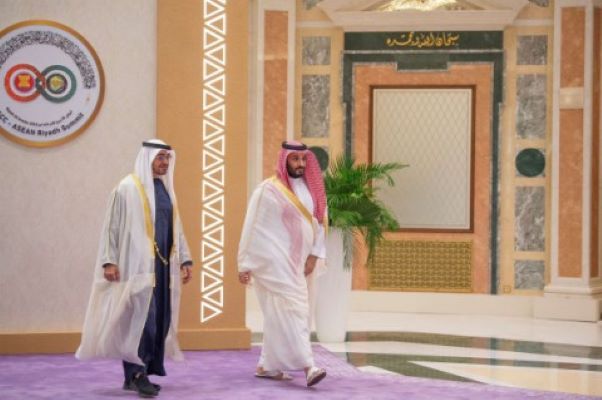
With whom will the Israeli-American alliance align? And why have the Houthis emerged as the biggest winners? What did “rebel” Prince Talal bin Abdulaziz and President Ali Abdullah Saleh tell me about Yemen’s wars in two historic testimonies?
They divided Libya, desecrated its leader’s remains, and plundered its assets. Then they moved on to Yemen, breaking away the country’s territorial unity by starting a ten-year conflict. They then moved on to Syria, overthrowing its regime and security forces and demolishing its geography. Now it’s the turn of Saudi Arabia and the UAE, dragging them into a financial, military, and human resource-draining war that could lead to the unavoidable collapse of the Gulf Cooperation Council, which was once a model of success as a geographical, political, and regional unifying alliance but is no longer relevant.
The UAE and Saudi Arabia have supported the American-Israeli project, whether knowingly or accidentally. The two countries are now at war on Yemeni territory after fighting in the same trench to overthrow the regime and the map of its political and demographic alliances. However, the outcomes of this new and predictable conflict will be different, and no winners may emerge. The effects may be similar to those of the 1994 Southern Separation War, which sought to undermine North-South integration. Yes, history repeats itself, but the outcomes may not align with the objectives of those who initiate the battle. It is worth noting that the previous Yemeni conflict lasted ten years; how long would the present war last if not contained quickly? All possibilities are likely in an already inflamed area.
Before addressing the developments of the war that has erupted on the ground in southern Yemen between the former allies, Saudi Arabia and the UAE, we believe it is necessary to return to two personal incidents that have been briefly mentioned as a testament to history; perhaps by reflecting on them, we can gain a deeper understanding of the current developments: • The first: In late March 2015, just a few days after the war in Yemen began, the rebellious prince “Al-Ahmar”, the late Talal bin Abdulaziz, called me and asked what I thought about what was going on (the invasion of Yemen) by the Gulf Cooperation Council armies and planes led by Saudi Arabia and the UAE. My argument was that this invasion was a historical sin and would never succeed, since Yemen is the graveyard of invaders, and no one has ever entered without being vanquished. The late prince agreed with all I stated.
Ali mentioned reading the memoirs of British general Abdullah Philby (who converted to Islam after marrying a Saudi Bedouin woman, changed his name from John to Abdullah, moved to the Kingdom, and served as an advisor to King Abdulaziz Al Saud). According to Prince Talal, King Abdulaziz told Philby, who objected to his decision to withdraw his country’s forces, which had invaded Yemeni territory under the command of his two sons, Princes Saud and Faisal, to return immediately, saying, “You do not know Yemen; it is the graveyard of empires.” • The second: In one of my meetings with late Yemeni President Ali Abdullah Saleh, following his victory over the southern secession attempt on May 22, 1994, the late president, who played the most important role in unifying the two halves of Yemen, said to me word for word: “I was confident from day one of victory, because the Gulf states supported the secession, and they have never supported anyone without suffering a major defeat, and I am one of them.”
In another meeting, President Saleh revealed to me that Saudi Arabia offered him hundreds of billions of dollars to “buy” an outlet to the Arabian Sea via Hadramout, with a width of 10 kilometres or less, under its sovereignty, to lay a pipeline for exporting Saudi oil away from the three straits: Hormuz, Bab el-Mandeb, and the Suez Canal.
This offer was emphatically refused, despite Yemen’s severe financial circumstances as a result of the secession war and Gulf blockade. Affirmed by President Saleh: “I proposed, out of necessity for money, that we lease this corridor for several years while maintaining Yemen’s sovereignty, but this proposal was rejected, and we paid the price by obstructing the border demarcation agreement and facing further blockade.”
Returning to the developments of the Saudi-Emirati conflict in Yemen, it can be stated that Saudi warplanes bombed two Emirati ships loaded with military equipment, weapons, and missiles in the port of Mukalla in Hadhramaut, which were about to be delivered to the Southern Transitional Council’s separatist forces (a claim denied by the UAE); Saudi Arabia viewed the attack as a violation of its red line. Saudi Arabia confirmed that it would take all necessary measures to confront any breach, in addition to other violations such as the Transitional Council forces’ “occupation” of oil wells in Hadhramaut and the tightening of control over Hadhramaut and Al-Mahra provinces, which account for half of Yemen’s territory.
This Saudi-Emirati military clash coincided with the Israeli occupation state’s announcement to recognise the “Somaliland” statelet, which involved displacing at least two million people from the Gaza Strip and establishing Israeli military bases on abandoned islands in the Red Sea to gain full control over the area, as well as on Socotra Island to control Bab al-Mandab, the Gulf of Aden, and the Arabian Sea.
This is the first time since the Gulf Cooperation Council was established that military conflict has erupted between two member states, with ships being bombed, threats escalating, and events being named as they are, far from rhetorical statements about brotherhood and common interests, bringing an end, perhaps definitively, to the phase of “deception”.
The question that strongly arises is: Will the scope of this war expand, drawing in other Gulf and global countries? In other words, will the UAE respond to Mr Rashad Al-Alimi, the head of the Yemeni Presidential Leadership Council (which is divided into two factions: four with Saudi Arabia and four with the UAE, led by Aidarus Al-Zubaidi), who has demanded that all of its forces withdraw from southern Yemen within 24 hours? And will this withdrawal end the crisis? And the other important question is, will Saudi Arabia expand its intervention and send its forces to control the southern Yemeni cities, such as Hadhramaut, Al-Mahrah, Sayun, and finally Aden, and completely end the presence and rebellion of the Southern Transitional Council? And how will the UAE react?
It is certain that the “Ansar Allah” movement, led by Mr. Abdul-Malik al-Houthi, which stands “neutral” and rejoices at the involvement of its enemies in this war, will emerge as the biggest winner, whether the war continues and expands, as everyone will seek its favour, or one of the parties involved raises the white flag, either unilaterally or in response to the demands of the mediators who will rush to offer their assistance. The warring parties possess not billions, but trillions.
Final question: What will the US and Israel’s positions be on this conflict, and which side will they support if it continues?
The certainty is that they will encourage its continuation for as long as possible to financially exploit its parties or to sell arms deals worth hundreds of billions, if not more.
The Gulf states’ biggest blunder was thinking Israel and the US would protect them from regional wars. Therefore, they completely isolated themselves from the Palestinian cause and remained neutral in the genocide in Gaza, Yemen, and Lebanon. Now, the fire has not only engulfed the hem of their garment, but has nearly consumed it completely.
It is the curse of Gaza… And the blood of its martyrs and their souls… The “Abraham Accords” also bear a curse, as do the days that separate us.
Is the Saudi-Emirati feud destroying the Gulf Cooperation Council?

0 thoughts on “Is the Saudi-Emirati feud destroying the Gulf Cooperation Council?”