 TheAltWorld
 What remains missing from the rhetoric of “Israel’s obligations”
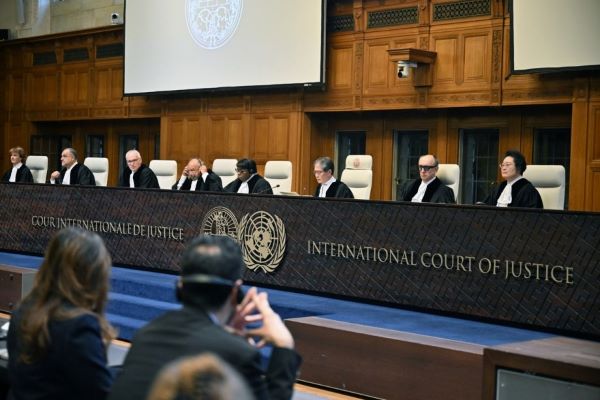
Last month, the International Court of Justice (ICJ) gave its advisory opinion on Israel’s obligations towards the presence of UN agencies operating in the occupied Palestinian Territories. The opinion was requested by the UN General Assembly, whose resolutions are non-binding to the point of not escalating beyond futile recommendations.
Despite the weight that resolutions and legal opinions ought to carry, based as they are on international law and obligations, both the ICJ and the UN General Assembly contribute to the Palestinian people’s subjugation. Both institutions have offered words, while the world supplied Israel with weapons and the means to commit genocide.
What the ICJ stated with regard to the UN Relief and Works Agency for Palestine Refugees (UNRWA) is both non-binding and not a novelty. Israel is obliged to lift its restrictions on UNRWA and the link between the agency’s mandate and Palestinian self-determination “underpin and reinforce Israel’s obligations to respect the mandate, status, privileges and immunities of UNRWA in the OPT.”
For decades, the entire world has heard the phrase “Israel, as the Occupying Power”. What international institutions fail to articulate to the world is that human rights have fallen into a chasm as a result of terminology that has lost both meaning and value. That loss, in turn has rendered all action to hold Israel accountable close to negligible, because Israel is deriving its strength from the impunity created by diluting international law.
There is an inherent weakness in international institutions when it comes to upholding human rights and international law. The colonised and the oppressed are forced to recreate themselves as fodder for this system that pledges protection of human rights while aligning itself with military might. It is by design that institutions are weaker than the international law violations they are supposed to prevent.
The ICJ concluded that Israel was “under an obligation not to impede the operations of United Nations entities, including UNRWA, and to cooperate in good faith with the United Nations to ensure respect for the right of the Palestinian people to self-determination.”
This sentence is one example of how international law serves Israel. If Israel acted accordingly, particularly with respect for Palestinian self-determination, the statement would serve no purpose. The underlying expectation is that Israel will not “cooperate in good faith”; it will continue trampling upon Palestinian self-determination through colonialism and genocide. As a result, UNRWA remains tethered to a mandate it cannot fulfil competently because of Israel’s impediments and insufficient funding. Who benefits from non-binding resolutions and advisory opinions? Israel, of course.
To expect Israel to fulfil its obligations as an occupying power is a contradiction in itself, even more when the root cause – Zionist colonisation – remains unaddressed. Advisory As an aberration of international law, Israel acts within the parameters of impunity offered by the weak institutions upholding the legislation. If international institutions want UNRWA to fulfil its mandate, and if Palestinian self-determination was truly a concern for the international community, where is the unified international call for Israel to decolonise itself?

0 thoughts on “What remains missing from the rhetoric of “Israel’s obligations””