 TheAltWorld
The Collapse of Our Societies
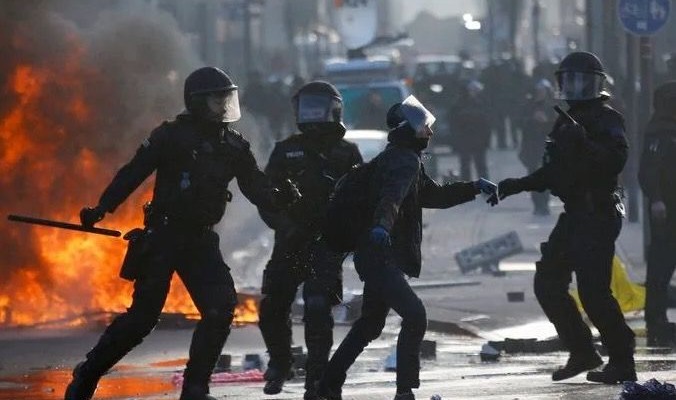
Southwestern Europe and India have been struck by significant protests, while the United States has been shaken by local elections. We tend to view these events as distinct, given that they occur in different geographical regions and take different forms. Yet, upon closer inspection, this is inaccurate: citizens everywhere are facing the same problems.
In a great many countries, we are witnessing protests against the high cost of living, as well as elections that result in the rejection of political leaders. While the specific justifications, implications, and consequences vary from one country to another, the underlying facts remain the same everywhere.
Clearly, we have pursued identical policies that are leading to the same catastrophes across the board. We must strive to understand this phenomenon, while being careful not to project our own experiences onto other cultures. Although most of the affected states belong to the “political West,” others—such as India—do not.
Portugal, Spain, France, Belgium, Germany, Switzerland, Italy, and Albania—a geographical cluster that historically shares the same inheritance laws—are particularly affected.
It is easier to provide a coherent description of states that are *not* experiencing social unrest than it is to describe those that are. Stable nations offer a sense of future prospects to their populations. This is notably the case for the Chinese civilizational bloc and the Russian bloc—two groups that continue to grow, whereas our own is beginning to stall in various places.
In general, people perceive domestic politics first, followed by foreign policy; they are not always aware of the connection between the two. Yet, everyone acknowledges that, in a globalized world, domestic policy is contingent upon the external environment. It is widely understood that the conflicts in Ukraine and the Gulf have driven up the prices of certain hydrocarbons and their derivatives—such as plastics, solvents, and pharmaceuticals. Yet, it is harder to grasp that the price of a food item packaged in plastic is linked to our support for Ukrainian neo-Nazis and the compliance of our banks with directives from the U.S. Department of the Treasury.
Some nations managed, for a time at least, to mitigate the impact of these price hikes. India and the United States, for instance, long circumvented the European Union’s “unilateral coercive measures”—misleadingly labeled “sanctions” by war propaganda—against Russia. Ultimately, however, both were caught up by their own alliances and their own missteps.
If we can stop trying to determine who is losing the most and instead ask why almost all of us are losing, we will realize that our primary problem is that we are not working for ourselves. This was the underlying sentiment behind the MAGA movement in the U.S., the rise of the independence movement in Quebec, and the emergence of figures like Karol Nawrocki in Poland.
In France, “not working for ourselves” means seeing an exorbitant portion of our income vanish into a myriad of obscure social levies. In theory, these funds are redistributed through public services and various welfare benefits; in reality, it is clear that the math simply does not add up. From a left-wing perspective, one observes the collapse of public services, one after another; from a right-wing perspective, one sees many social benefits being paid out to individuals who have no legitimate claim to them. Be that as it may, it is difficult to accept that the Germans who protested in Frankfurt against the Merz government and the Americans who voted against the Trump administration are driven by the same fear of failing to make ends meet.
Two other demands are emerging. The first concerns corruption. It stems from the feeling that one is not working for oneself, but is instead being exploited by “the” system.
Yet, the forms and levels of corruption vary significantly from one country to another. While in France we might accept the government distributing checks to certain segments of the population on the eve of an election, we are taken aback to hear the President of the United States announce that he will distribute checks to his fellow citizens, provided they vote in large numbers for his party. In general, corruption only becomes an issue when there is a sense that our leaders cost the community far more than they contribute to it. Today, the fear is that our leaders offer us nothing, yet still help themselves to the spoils along the way. This does not necessarily mean that we are aligning ourselves with any particular ideology. And this explains why challenging corruption has become the hallmark of Generation Z—a generation that may not yet have an ideology, but already has the eyes to see.
Another demand, prevalent throughout the West and in India, is the rejection of social inequality. In the case of India, one naturally thinks of the persistence of the caste system, which prevents some people from marrying and others from finding employment. In the West, inequalities are primarily financial. Our conception of democracy assumes that all voters have an equal capacity to assert their points of view. We become uneasy when some individuals possess such exorbitant financial means that they could use them to shape society according to their own personal desires, without any regard for the wishes of others. This system can no longer function when, for instance, France has around 2.5 million millionaires and about a hundred billionaires—while the United States has a “trillionaire,” a figure who stands among the billionaires much as a millionaire stands among ordinary people. Yet, because we have no idea how to organize ourselves in such a situation, we prefer to simply ignore the problem.

0 thoughts on “The Collapse of Our Societies”