 TheAltWorld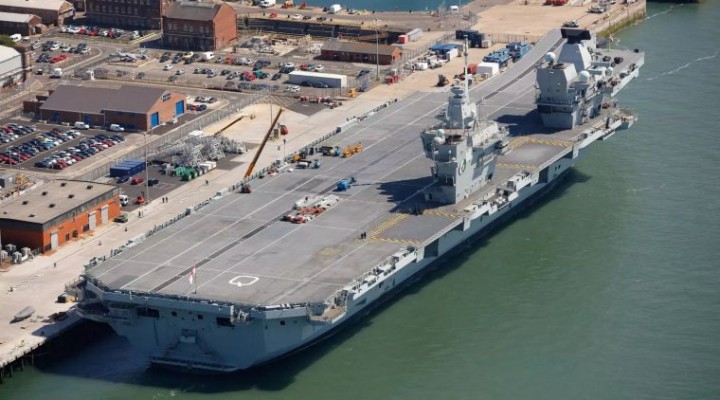
‘Effective ally’
The files highlight the political importance officials attached to Britain possessing aircraft carriers, and especially for upholding British power as seen by the US.
In response to Darling’s plea to Blair, the PM’s personal adviser, Roger Liddle, defended the need for the carriers, citing the recent deployment of HMS Invincible to the Gulf to “deter” Saddam Hussein’s Iraq.
He added that “being an effective ally” of the US “involves more than passing resolutions and offering moral support. It requires power and the willingness to use it alongside your friends”.
Liddle had earlier told Blair that “there is a school of thought that believes carriers are extremely vulnerable to attack”. However, “it seems right to maintain the ability to project power by sea when so many of the risks to our security are in the Mediterranean and the Gulf”.
Liddle concluded by noting: “Were we to abandon carriers, we will be seen as having abandoned a potent symbol of Britain counting for something in the world”.
Blair’s defence secretary, George Robertson, similarly noted that the aircraft carriers could be militarily vulnerable but had political importance.
He told Blair in January 1998 that “although carriers were vulnerable in the unlikely event of total war, they were large, visible, mobile and carried their own message”.
‘Our high standing in the world’
When David Cameron became prime minister in 2010 he initially proposed cancelling the carriers but was told it would cost more to cancel the contracts with the shipbuilders, led by BAE Systems, than to continue building them.
Britain formally launched two new aircraft carriers – HMS Queen Elizabeth and HMS Prince of Wales – in 2017 and 2019, at a cost of £6.3bn. The new warplanes to be put on them were estimated in 2018 to cost a further £13bn.
Lord Richards, a former chief of defence staff, told journalist Richard Norton-Taylor that the carriers were “behemoths…unaffordable vulnerable metal cans”. They have since been plagued by serious mechanical problems.
The British political and media establishment is currently demanding an increase in military spending to face the alleged rise in threats to national security. Yet the files suggest that the motives for Britain having a strong military are not always those publicly claimed by officials.
A “strong” defence policy “gives us the lead on defence in Europe, ensures US respect and guarantees our high standing in the world more widely”, Blair’s foreign policy adviser John Sawers, wrote to Tony Blair in June 2001. Sawers would go on to become chief of MI6.
Blair’s defence secretary Geoff Hoon told his boss something similar in June 2003, saying that “our armed forces are a key lever… to influence US strategy”, referring at the time to the wars in Afghanistan and Iraq.
‘Huge’ cost of aircraft carriers meant ‘less scope’ for funding health and education

0 thoughts on “‘Huge’ cost of aircraft carriers meant ‘less scope’ for funding health and education”