 TheAltWorld
 US Cements Political Capture of Armenia as it Advances “Extending Russia” Strategy
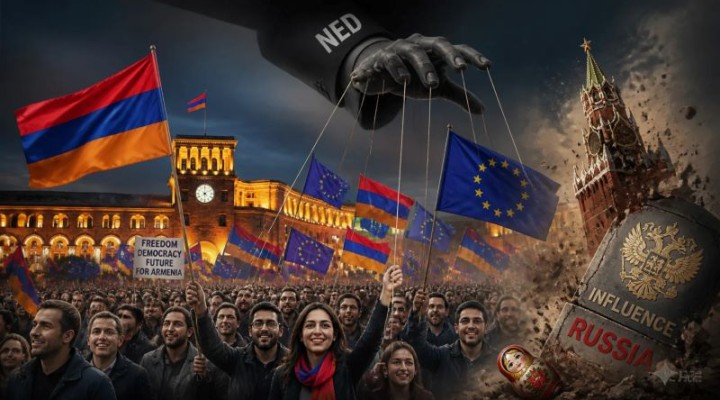
The United States continues pursuing its decades-spanning policy of maintaining global primacy by encircling and containing rivals as described in the 1992 New York Times article, “U.S. Strategy Plan Calls for Insuring No Rivals Develop.”
For Russia specifically, the RAND Corporation’s 2019 paper, “Extending Russia: Competing from Advantageous Ground,” lays out policy options the US has clearly pursued for years leading up to its publication and ever since.
These options targeting Russia include those of an economic dimension such as “hinder petroleum exports,” “reduce natural gas exports and hinder pipeline expansions,” and “impose sanctions,” as well as geopolitical measures like “provide lethal aid to Ukraine,” “increase support to the Syrian rebels,” “promote regime change in Belarus,” “exploit tensions in the South Caucasus,” “reduce Russian influence in Central Asia,”and“challenge Russian presence in Moldova.”
Virtually all of these options have been implemented in one way or another —from the US sending lethal aid to Ukraine the same year this paper was published under the first Trump administration to the continued arming of terrorists in Syria by the US, culminating in the collapse of the Syrian government in 2024, to the physical destruction of the Nord Stream pipelines as well as constantly expanding US-led sanctions and maritime interdiction operations targeting Russian energy exports.
Exploit Tensions in the South Caucasus: Politically Capturing Armenia
In light of the recent elections in Armenia (in the South Caucasus region) and the President of the European Commission, Ursula von der Leyen, congratulating Armenian Prime Minister Nikol Pashinyan by exclaiming, “the spirit of the Velvet Revolution you led in 2018 is alive and well,” it appears that once again the US objective of “extending Russia” has been further advanced.
While many have been tempted to assign Armenia’s pivot away from its traditional Russian partnership to the European Union and NATO to European influence, the US government itself engineered the protests in 2018 von der Leyen referenced, with the National Endowment for Democracy (NED) itself admitting in its 2018 annual report that:
NED’s many grantees in Armenia were in the forefront of the “Velvet Revolution” last spring that swept from office a corrupt and autocratic president who wanted to manipulate the constitution to retain power. In subsequent elections held in December, the party alliance of the new Prime Minister Nikol Pashinyan won 70 percent of the vote, setting the stage for building accountable and effective government ministries, reforming the judicial system, and strengthening the media as a critical watchdog over government performance.
By “corrupt and autocratic,” the NED means a government that does not answer to Washington at the expense of its own national interests, and by “accountable and effective ministries,” the NED means accountable to and effective at serving Washington — even at the cost of Armenia’s own interests.
Organizations involved in the US-engineered “Velvet Revolution” in Armenia and the subsequent cementing of US political capture over the nation include the “Union of Informed Citizens,” whose 2021 annual report admitted extensive US government backing and direction continued well after the 2018 protests —a s well as Boon TV, which is admittedly funded by the NED’s European counterpart, the unimaginatively named “European Endowment for Democracy.”
Just like with other nations the US has politically captured, Armenia’s “color revolution” and “regime change” were just the beginning. With a client regime in place, the floodgates of foreign interference by the US are opened.
The NED reported the following year in its 2019 annual report that US government interference shifted from producing desired outcomes during elections to consolidating political control in their aftermath, noting, “Since the 2018 revolution in Armenia, NED grantees have shifted their focus from holding a corrupt regime accountable to supporting governance reform.”
Again — language like “corrupt regime” and “reform” translates into a government unwilling to subordinate itself to US interests and consolidating US control.
The same 2019 NED annual report notes how “several NED grantees have entered government,” demonstrating how US-engineered protests not only seek to overturn a targeted government but also replace it with a US-prepared and selected client regime.
NED subsidiaries like the National Democratic Institute (NDI) announced in their own 2020 report regarding Armenia the launching of two programs, “the Intern Program of the National Assembly of Armenia and the Katarine Women’s Political Leadership Program.”
The same report mentioned, “a graduation ceremony for the Institute’s Young Political Leadership Strategy Program.”
In other words, the NED and its subsidiaries and European counterparts are not just funding protests, and opposition parties, and placing client regimes into power, but are creating a much wider pipeline for transforming young people into pro-Western, pro-American, pro-NATA and pro-EU cadres and manipulating public sentiment into serving US interests at the cost of their own, objectively best interests.
The political capture of Armenia by the United States mirrors that of Georgia and Serbia in the early 2000s and the more recent political capture of Ukraine in 2014.
The London Guardian, in its 2004 article, “US campaign behind the turmoil in Kiev,” admitted the protests in Ukraine that year were, “an American creation, a sophisticated and brilliantly conceived exercise in western branding and mass marketing that, in four countries in four years, has been used to try to salvage rigged elections and topple unsavoury regimes,” that “the campaign was first used in Europe in Belgrade in 2000 to beat Slobodan Milosevic at the ballot box,” and that “Richard Miles, the US ambassador in Belgrade, played a key role. And by last year, as US ambassador in Tbilisi, he repeated the trick in Georgia.”
Again, terms like “rigged elections” and “unsavory regimes” translate into elections that did not turn out the way the US preferred and governments not yet subordinated to Washington.
Extending Russia
Within the 2019 RAND Corporation paper, “Extending Russia” under“Measure 4: Exploit Tensions in the South Caucasus,” US policymakers specifically mention Armenia.
The paper states:
The United States could extend Russia in the Caucasus in two ways. First, the United States could push for a closer NATO relationship with Georgia and Azerbaijan, likely leading Russia to strengthen its military presence in South Ossetia, Abkhazia, Armenia, and southern Russia.
Alternatively, the United States could try to induce Armenia to break with Russia.
The paper unapologetically admits the capture of Armenia — as well as Georgia — would enhance the encirclement of not only Russia but also neighboring Iran as well as provide the US access to energy resources in the Caspian Sea.
The paper explicitly states:
While the principal aim of these policies would be to extend Russia, closer relationships with Georgia, Azerbaijan, or Armenia might yield important secondary benefits for the United States. The geographic position of Azerbaijan makes it a prime location for both intelligence gathering and deterrence measures relating to Iran, especially because many of Iran’s Kurdish and Iranian populations are concentrated near the Azeri-Iranian border. Stronger ties with Georgia, hailed by the conservative Heritage Foundation as “one of America’s best allies in Europe” for providing one of the largest contributions of troops to Iraq and Afghanistan, could pay strategic dividends in the future.
Increased U.S. involvement in the region could produce additional economic benefits as well. The Caspian Sea remains a key producer of both oil and natural gas. Indeed, the U.S. Department of Energy estimates that there are “48 billion barrels of oil and 292 trillion cubic feet of natural gas in proved and probable reserves in the Caspian basins. Almost 75 percent of oil reserves and 67 percent of natural gas reserves are located within 100 miles of the coast.” A closer political relationship with Azerbaijan would help secure continued access to these resources for the United States and—perhaps more important— for its allies in the future.
Far from ensuring US national security, US foreign policy is predicated entirely on compromising the national security of all other nations around the globe — “friends”and foes alike. The goal is to first subordinate as many nations as possible, then encircle, contain, and eventually collapse those it cannot.
While the 2019 RAND Corporation paper feared “flipping” Armenia would likely be difficult, it appears the US has successfully managed to do so nonetheless.
This may be in part due to the entire premise of the paper itself, “extending Russia.” An overextended Russia may focus more resources on one crisis the US creates for it — say, in Ukraine — at the expense of being able to prevent other US-created crises from overwhelming its available resources elsewhere.
Syria – mentioned specifically in the RAND Corporation paper – is one such example. Russia’s military commitment to fighting against the US proxy war in Ukraine left little resources to continue defending Syria from a similar US-backed proxy war in West Asia, resulting in the collapse of Syria in late 2024. Prior to 2022, Russia had not only stopped the advance of US-backed terrorists in Syria, but managed to stabilize Syria for several years.
“Extending Russia” may have forced it to likewise concentrate resources on preserving its relationships with nations like Belarus and perhaps Georgia at the expense of other nations like Armenia for the time being.
Washington’s Unnoticed Superweapon
The admitted election interference and political capture of these nations by the United States spanning the entire 21st century have changed the global geopolitical map in Washington’s favor. Yet this process still remains a poorly understood, underreported, yet incredibly powerful US tool in its pursuit of primacy and its “ensuring no rivals develop.”
Nations like Russia and China are clearly aware of this US method of infiltrating and capturing the political, educational, cultural, and informational space of targeted nations along their respective peripheries and beyond — leading to the subsequent hijacking and transformation of these nations’ military and economic power from serving self-preservation to serving as self-destructive proxies aimed at both nations.
Both nations, through government and media programs, have published reports and documentaries detailing the process — but often long after US success.
Unfortunately, the state media of both nations have repeatedly failed to “get ahead” of US infiltration and subversion — often with both Russian and Chinese state media simply repeating Western media narratives depicting protests organized by the US as “pro-democracy” or “anti-corruption” movements — thus amplifying US information warfare.
While both nations have “proofed” themselves against this form of US interference and political capture, they have failed to provide their partners and allies with the means to defend against this threat as well.
Both Russia and China have created their own domestic social media platforms and have displaced US-based social media platforms, which are used specifically to capture and control a targeted nation’s information space. Yet neither nation has successfully exported either these social media platforms themselves or the capability of creating domestic versions of them in partner nations to secure their respective information spaces.
Global campaigns, forums, and other formats used to raise awareness of US political infiltration and political capture have been meager and ineffective in exposing US methods and the dangers they pose — even as the glow of Ukraine’s burning to the ground serves as a warning to the world of the final destination awaiting US politically captured nations.
At the moment, Armenia is transitioning into another US-captured battering ram to use against both Russia and Iran.
In the Asia-Pacific region, the US is likewise rapidly transforming the Philippines into the “Ukraine” of Southeast Asia vis-a-vis China.
Other nations around the globe leaning toward the multipolar world Russia, China, and Iran advocate, remain targets of US infiltration and political capture, with armies of NED-funded organizations hard at work, quietly building up not only opposition parties to protest in the streets and interfere in elections, but also through the US capture of their respective information spaces — misleading the public into believing US interests are somehow “their own” interests.
Russia and China both provide partner nations with the military means of defending their traditional national security domains — air, land, and sea. A concerted effort to both expose the danger the US poses to non-traditional national security domains like political and information space and to provide a package of technologies and methods to defend against this danger could provide these nations the ability to thwart Washington’s aggression this century, similar to the military backing provided to nations like Vietnam to defend themselves last century.
Nations must create educational and training pipelines within their own borders to produce the human resources required to both administer the nation and inform the public of national affairs through the media. Sending young people abroad to the West to study “journalism” or “political science” only ensures their indoctrination by the West and their likely lifelong service to the West when they return home.
Infrastructure essential to this process, such as social media platforms, is as important to be controlled within a nation’s borders as are physical roads, borders, shores, and airspace. In the 21st century, allowing US-based social media platforms to dominate any other nation’s information space would be like allowing US troops to mine another nation’s roads, borders, shores, and airspace. If the latter is unthinkable, why is the former still the norm?
Until nations around the world can first see this danger to their political and information space as clearly as they see military threats to their physical borders and take the steps required to secure them, the US will continue to exploit this advantage, often toppling and capturing entire nations without deploying a single US soldier or firing a single shot, all before feeding these captured nations into regional proxy wars as well as global campaigns of political and economic pressure against Washington’s enemies — all to Washington’s benefit and at the expense of everyone else.

0 thoughts on “US Cements Political Capture of Armenia as it Advances “Extending Russia” Strategy”